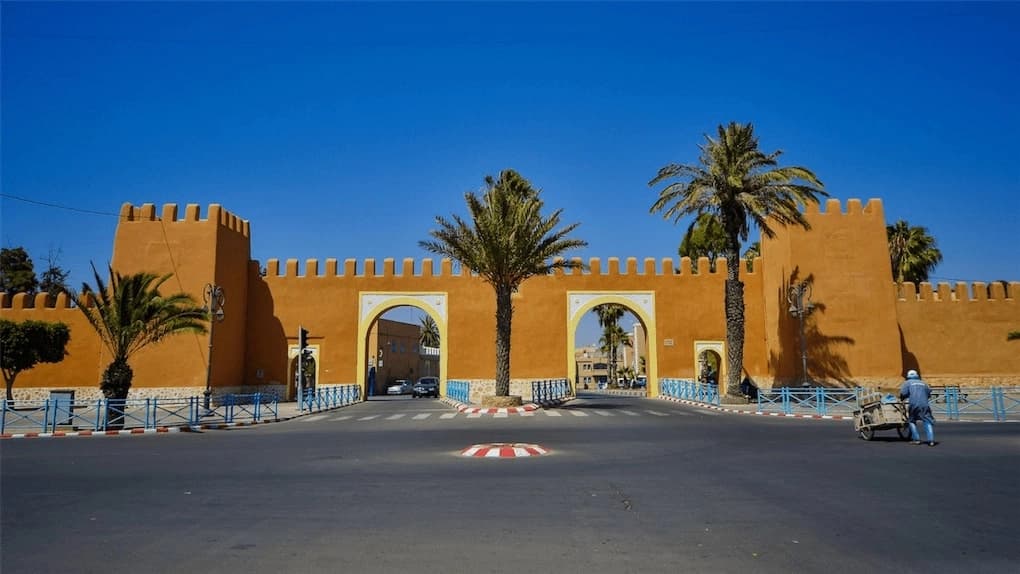
Tiznit, an hour and a half from Agadir, is announced by an ochre door in an adobe rampart and by a continuous metallic clink: a hundred jewelers' hammers at work.. An hour and a half later, you pass through an ochre door in an adobe rampart. The noise changes abruptly: no music, no touts, just a metallic tinkle that recurs every two or three seconds. It's a hammer. And it's hitting a hundred others, all over the medina. You've just entered Tiznit.
Infos pratiques
Why Tiznit isn't a stage, it's a parenthesis
When we talk about southern Morocco, everyone thinks of Essaouira, Marrakech and the desert. Tiznit is rarely mentioned. This is precisely what makes it one of the last places where you can still see the Moroccan south as it lives, and not as it is staged for visitors.
Tiznit is not a museum town. It's a lively Berber city, with a population of around 75,000, where people trade, pray and walk home at night. The 7-kilometer ochre ramparts trace an almost perfect circle around the medina. No skyscrapers. No traffic lights. No horse-drawn carriages waiting for tourists. Just daily life at its own pace, indifferent to your passing.
And it's precisely this rhythm that finally catches you. You slow down. You sit down. You watch a jeweller carving a silver fibula 60 centimetres away from you, without him asking you anything. You understand why people who visit Tiznit rarely come back for a second time: they stay longer than they expected the first time.
The legend that gave the town its name
Before the ramparts, before the sultan, before the first jeweler, there was a woman. Berber oral tradition tells us that in the heart of this arid plain, a certain Lalla Zninia, repentant of a life spent wandering, collapsed from thirst. According to one version, her dog scratched the ground and brought forth a spring. According to another, God himself sprang the water at her feet to signify his forgiveness.
This spring still exists. Today, it's called Aïn Aqdim, "the ancient spring", also known as Source Bleue. It's located inside the medina, in a rehabilitated garden that's well worth a visit. The water is still there, like a thread linking the town to its founding legend.
It was in 1882 that the town took on the shape it has today. Sultan Moulay Hassan I, on a military campaign to regain control of the Souss and counter European influence on the Atlantic, ordered the construction of these famous ramparts. Nine gates, thirty-six watchtowers, seven kilometers of adobe: Tiznit became a stronghold. Legend meets military strategy.
The jewellers' souk: the silver soul of Tiznit
If Tiznit has forged a reputation beyond its ramparts, it's thanks to one craft: silverworking. More than a hundred jewelers' workshops are concentrated in one street and its offshoots, in the heart of the medina. It's one of the few places in Morocco where you can still watch a master craftsman draw a silver wire, hammer it, weld it, chisel it, right in front of you, without staging.
What Tiznit jewellers make
The emblematic pieces are fibulae, the large triangular brooches that Berber women once wore to fasten their fabrics. Alongside them, you'll find ceremonial daggers, pendants, chiselled bracelets and antique rings. Many of the pieces are based on centuries-old motifs: the southern cross, the Tiznit sun, the eight-pointed star.
Prices are negotiable. Count 200 to 400 dirhams for a simple silver ring, 600 to 1,500 dirhams for a medium-sized fibula, and more for antique pieces. Check the hallmark: a "silver 925" (sterling) hallmark guarantees the quality of the metal. The best craftsmen won't be offended if you ask to see it: in fact, it's a good sign.
How to buy without getting ripped off
The golden rule in Tiznit: don't buy from the first store. Visit three or four workshops, ask prices for similar pieces, and look for craftsmen who work on site rather than those who simply resell. Real workshops can be identified by the noise they make: hammers, flashlights, files. Pure resellers are quieter and more urgent.
If you want to go further, ask to see the backroom: this is often where the craftsman's workshop is located, with his tools and work-in-progress. A master jeweler is almost always willing to show you how he works. It's free, and one of the best souvenirs you'll take home with you.
Places to see in the medina
Tiznit's medina can be traversed in a morning, but it's worth spending two or three days there to digest it. Here are the key sights, in the order in which they would logically be visited on foot.
The ramparts and their nine gates
Seven kilometers of walls, punctuated by thirty-six round adobe towers. The most impressive gate is Bab Jdid, in the southeast. The Bab Targa gate to the west overlooks the palm grove. For a complete panorama, climb the southern section of the ramparts in the late afternoon: the low-angled light turns the adobe a coppery red.
El Mechouar Square
This is the historic heart of the city, the ancient square where the sultan received the allegiance of the tribes. Today, it's a large open space lined with cafés, where local life gathers at the end of the day. Sit back, order a mint tea at 10 dirhams, and watch. Old people chat, children cycle by, women return from the market. Tiznit in twenty minutes.
The Great Mosque and its stick minaret
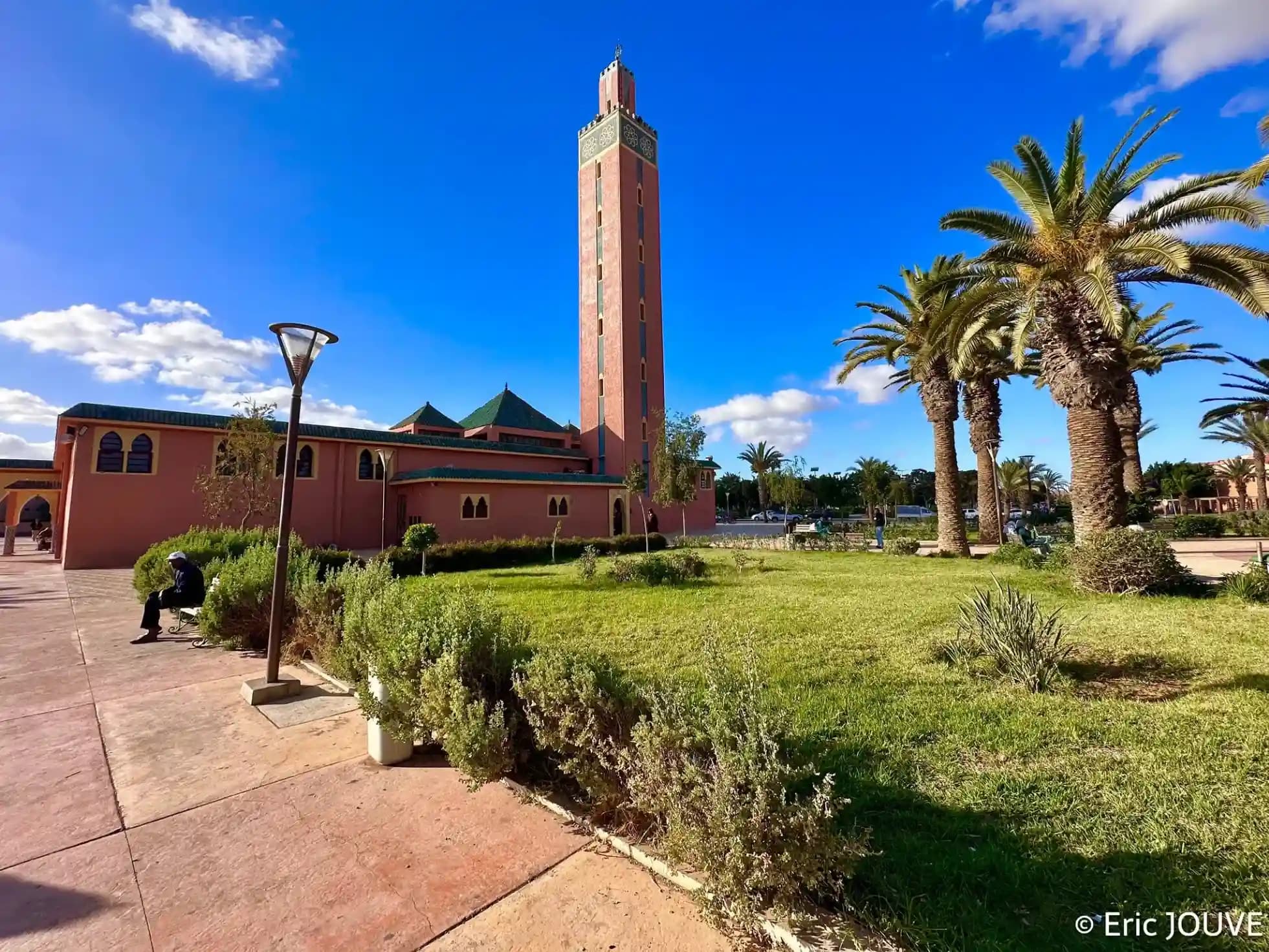
The Jamaâ Al Kabir mosque is not accessible to non-Muslims, but its minaret can be admired from the street. Its special feature: dozens of wooden beams protrude from all four sides. Legend has it that they allow the souls of the deceased to come and rest. The architecture is typical of southern Morocco, and can be found in a number of mosques in the Souss region.
Aïn Aqdim, the Blue Spring
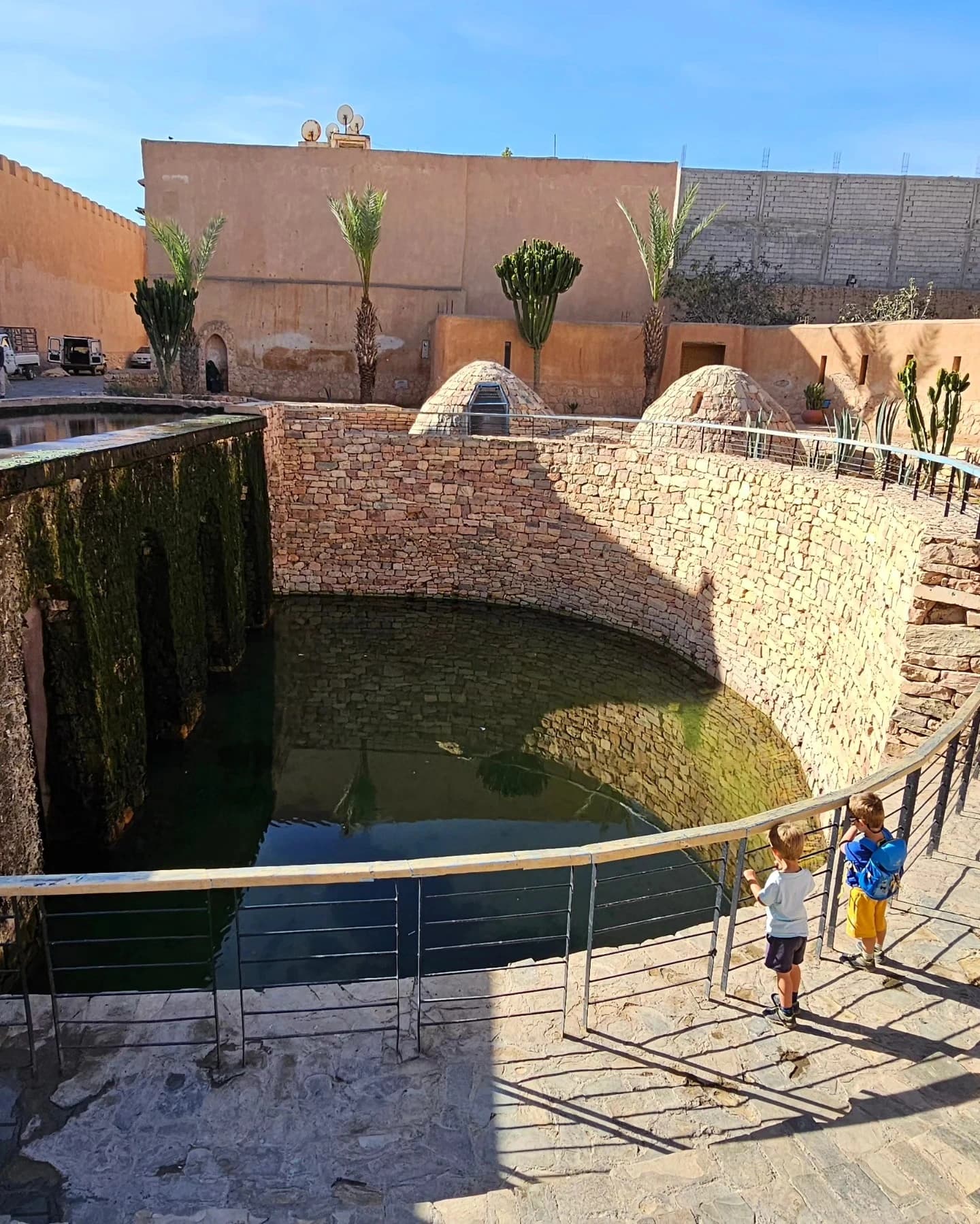
In the heart of the medina, in a walled garden rehabilitated in recent years. This is where the legend of Lalla Zninia takes root. It's a quiet, shady spot, ideal for a break from walking through the souk. Admission is generally free, sometimes 10 dirhams.
Thursday market
If you can schedule your visit on a Wednesday evening or Thursday, do so. The weekly souk transforms the main street and spills over into Place El Mechouar. Producers from the surrounding mountains, spice sellers, fabric merchants, suppliers of raw silver for jewelers: it's a chance to see Tiznit in its primary function as a commercial crossroads.
Eating and drinking in Tiznit
Tiznit's cuisine is that of the Souss region: argan oil everywhere, local honey, cumin and saffron. No Michelin-starred restaurants, but a handful of simple addresses well worth the detour.
For a tajine of chicken with lemon confit or meat with prunes, count 60 to 90 dirhams in a medina gargote. The best establishments are often to be found in the streets leading off Place El Mechouar. Couscous is traditionally eaten on Fridays: if you're in town that day, ask the owner of your guesthouse if she can prepare one for you.
Try amlou, a Berber spread made with roasted almonds, honey and argan oil. It's one of the specialties of the Souss region, and Tiznit produces excellent quality. You can buy it in the souk for 60 to 100 dirhams a jar.
Mint tea, known locally as "Berber whisky", is served everywhere, at all hours. Refusing tea is rare and more offensive than not finishing it. If you buy a piece of jewelry, expect to have a drink with the jeweller: it's Moroccan haggling masquerading as hospitality.
Beyond the ramparts: three not-to-be-missed excursions
Tiznit is the perfect base for exploring an unspoilt coastal and mountain strip. Three directions, three very different atmospheres.
Aglou beach (15 km west)
This is the beach at Tiznit. A long strip of Atlantic sand, low cliffs, a few surfers' camps in winter. No stores, no boardwalk: just the ocean and the wind. Aglou is where the locals come for a breath of fresh air on Friday evenings and Sundays. The sunset here is more than memorable.
Mirleft and the wild coast (50 km to the south)
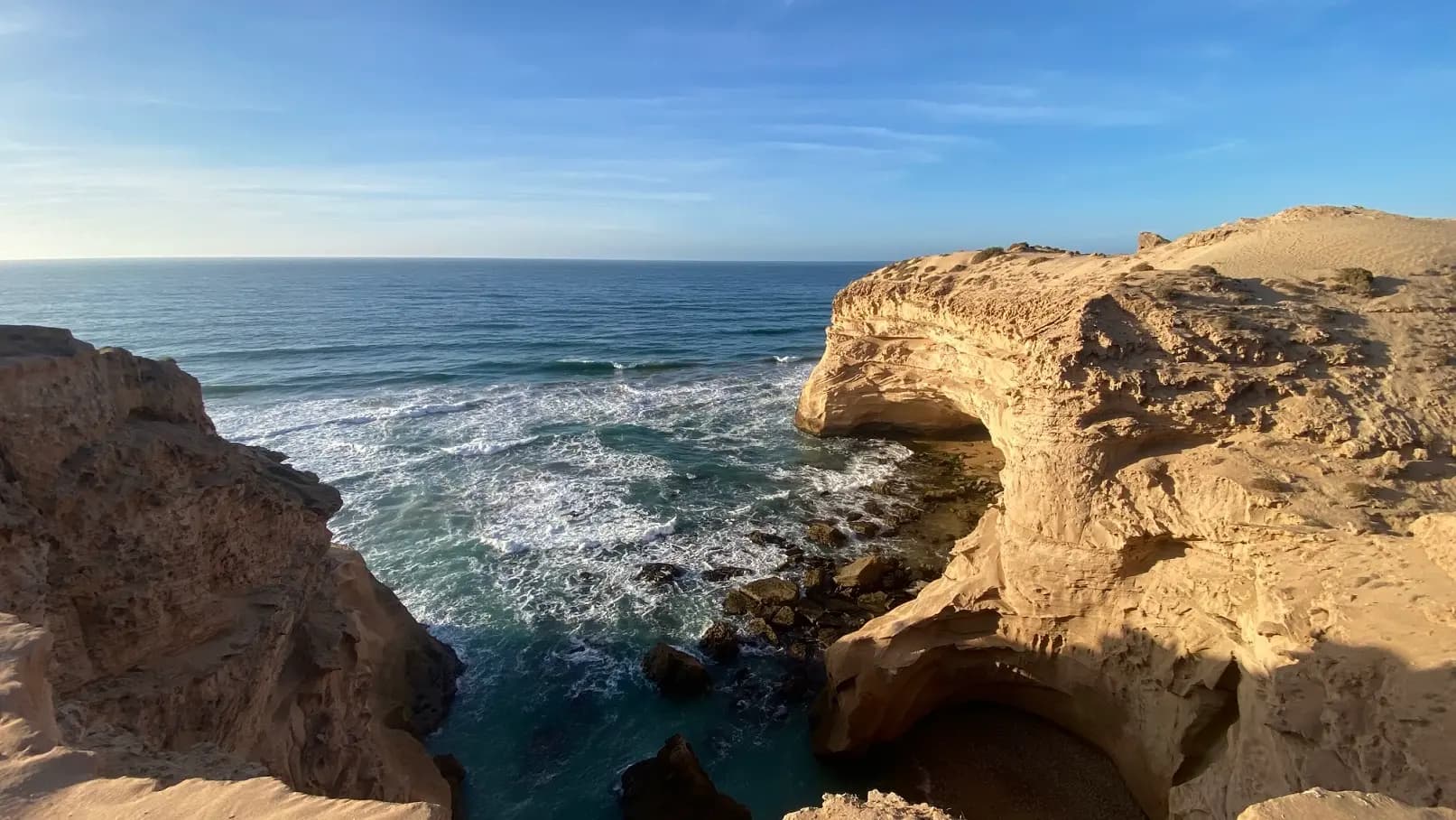
A 45-minute drive away, Mirleft is an ancient fishing village perched on a cliff above the Atlantic. Five of the seven nearby beaches are renowned surfing spots. The atmosphere is one of terraced cafés, blue-shuttered houses and roads that plunge down to the sea. Continue 30 km south to Legzira, a beach where natural arches of red sandstone have been sculpted by the ocean. Not to be missed at sunset.
Tafraoute and the Anti-Atlas (130 km east)
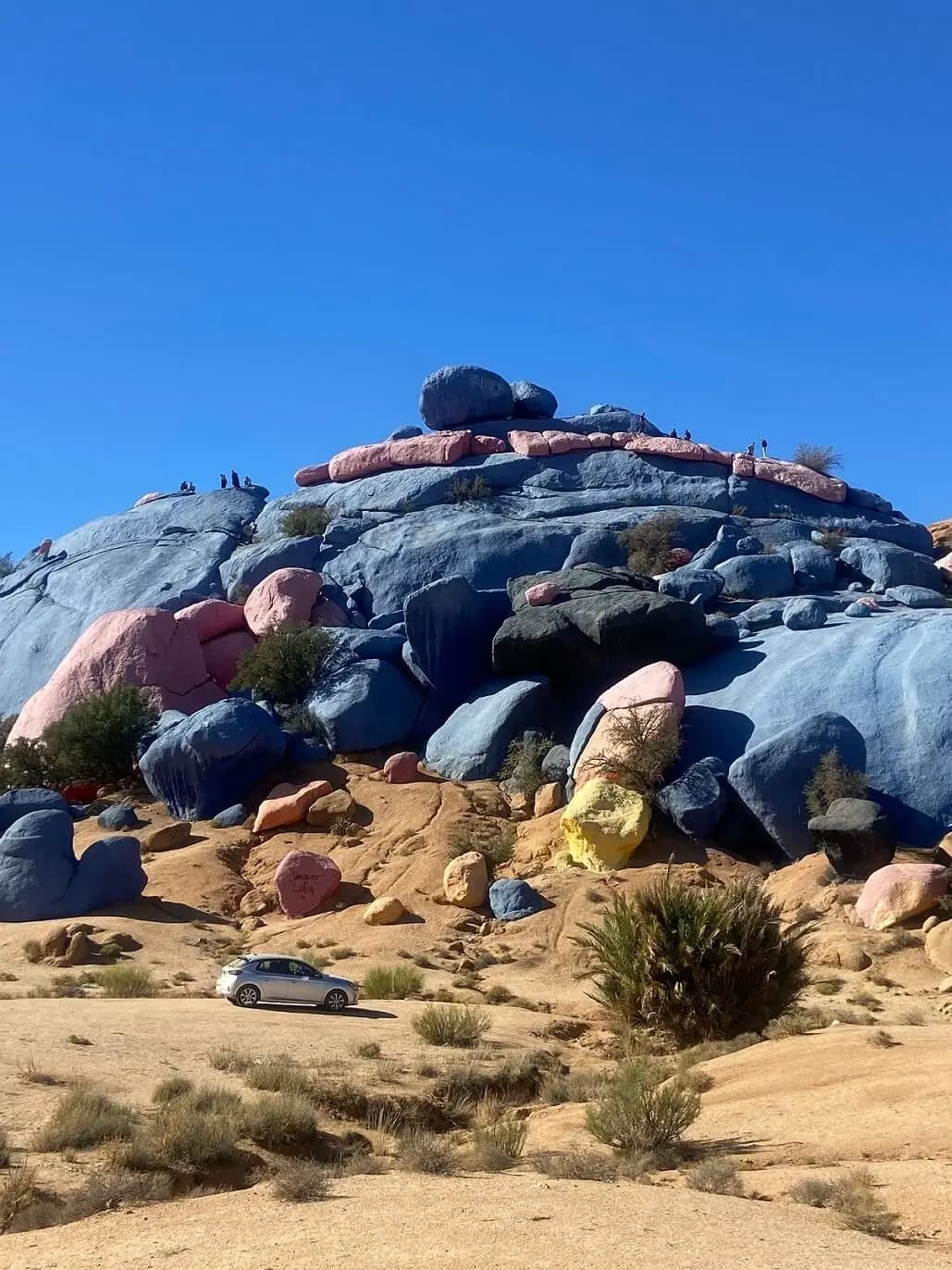
For lovers of mineral landscapes: the road from Tiznit to Tafraoute crosses the Berber Anti-Atlas. You'll come across almond trees in bloom (in February), adobe villages clinging to the mountainsides and palm groves. Tafraoute, set in the middle of a pink granite cirque, is one of Morocco's most photogenic landscapes.
How to get to Tiznit from Agadir
By rental car
This is the easiest option. 95 kilometers on the N1, road in good condition, allow 1h30. You'll cross the Souss plain, with its citrus orchards and tomato greenhouses. A short stop at Aït Baha is possible if you take the more picturesque inland route. Free parking around the ramparts, with a charge near the gates (10 to 20 dirhams).
By bus CTM or Supratours
The most economical way. Several departures a day from Agadir, 2h15 journey, around 50 dirhams per person. The Tiznit bus station is outside the ramparts, but a 10-minute walk from Bab Jdid. Book online at ctm.ma or supratours.ma.
In a big cab
Faster but less comfortable. Continuous departures from Agadir's cab rank, 35 to 50 dirhams per person when the car is full (six passengers). Allow 1h15 for a brisk journey.
Organized excursions
Several operators offer day trips to Tiznit from Agadir, often combined with Mirleft and Legzira. This is the easiest option if you don't want to drive and want to maximize your time. For an immersive trip where Tiznit is part of a wider tour of the south, take a look at ourexcursions from Agadir.
When to come and where to sleep
The best months
From October to April, the climate is ideal: 18 to 25 degrees during the day, cool nights, often clear skies. Avoid June to August: the Souss plain can rise to 40 degrees, and the medina, enclosed by its ramparts, keeps the heat in. If you come in summer, plan your outings for early morning and evening.
How many days to allow
One day is enough to see the essentials, but two days will allow you to experience the medina beyond tourism. Three days are needed if you want to add Aglou and Mirleft.
Where to sleep in Tiznit
The most memorable experience takes place inside the ramparts, in one of the Berber guesthouses that have been reopening their doors in recent years. Expect to pay between 300 and 600 dirhams per night for a double room with breakfast. The owners are often French-speaking locals who can direct you to the city's best craftsmen.
If you prefer more comfort, several modern hotels are located outside the ramparts, in the new town. Less charm, more standing, from 500 dirhams per night.
Tiznit in an immersive journey through Morocco
Tiznit is not a self-sufficient destination. It's a link. It really comes into its own when part of a wider itinerary that crosses ocean, mountain and desert.
A five- to seven-day loop from Agadir can combine: morning jewelers in Tiznit, afternoon beach in Aglou, evening in Mirleft, Legzira day, climb to Tafraoute, return through the Anti-Atlas. The scenery changes every hour, and so does the atmosphere.
To make the experience even more memorable, several of our tours include a workshop at a Tiznit jeweller's: you leave with a piece you helped to make, and the voice of a craftsman who has told you why he has been doing this for thirty years. This is what we call an immersive journey: not just passing through, but understanding.
If Tiznit appeals to you, leave fromguide to Agadirwhich serves as a logical starting point. And to prolong the "money and craftsmanship" spirit, read our article on theKasbat Souss, Agadir's artisan villageTwo Moroccan variations on the same craft, passed down from generation to generation.
In a nutshell
Tiznit is not a town to check off a list. It's a town to stay in for a few days, just long enough for the medina to adopt you. Here you'll find what the big cities of the north have lost: a rhythm, a silence, a know-how still held by hands that pass it on to sons and grandsons.
If you come down from Agadir for a day, you'll leave with a ring and a story. If you stay for two nights, you'll leave with something else, more difficult to put into words. Something like the impression of having found the most unspoilt version of the Moroccan south. And that's exactly why we go.