
Agadir
From the open sea off Agadir to the dunes of Merzouga - 5 days in the company of artisans and nomads
- Free cancellation up to 72h before
- 100% secure payment on the site
- Guide speaking FR, EN, AR
- WhatsApp reply within hours
- Small group: 6 travellers max
About this tour
Your itinerary
Day by day
Your travel companion will be waiting for you outside the airport or in your hotel lobby. No laminated sign, no group to join: a handshake, a few words to get a feel for the trip, and off you go. This first day is intentionally short - it’s meant for dropping off your luggage, breathing in Agadir’s salty sea air, and making sure you’re not tired going into the next four days.
Agadir is a seaside city built after the disaster of 1960: modern, lively, and sometimes surprising to those who expected a medina. Tonight, over dinner, your tour guide will trace the route for the coming days on a map - the Anti-Atlas mountain passes, the red-earth kasbahs, the horizon fading into the desert. It’s a way to begin getting a sense of the country before setting out to explore it.
Meals included
- Dinner
Accommodation
Overnight stay at a hotel in Agadir - a comfortable room overlooking the city, just a stone's throw from the Atlantic coastal road.
We set out early, before the heat sets in. The road leaves the coast and winds its way up into the Anti-Atlas Mountains through tight hairpin turns. The villages change colour as the elevation increases - ochre adobe, whitewashed walls, terraced houses that seem to be perched on the mountainside. Your guide knows the names of every pass and the stories that took place there.
The Kasbah Taourirt in Ouarzazate is worth a stop - not as a mandatory tourist stop, but to understand how entire families lived in these adobe structures, and how the architecture adapted to the climate before concrete arrived. The Atlas film studios are right next door: a reminder that the Moroccan desert has served as the backdrop for dozens of international productions, often benefiting the local economy.
The most anticipated stop of the day is in the Valley of Roses, before heading to the Dades Gorges. A women’s cooperative welcomes you: the copper still heats gently, and the steam laden with Rosa damascena petals condenses into pure rose water.
The manager explains the harvest schedule - ten days in April, at dawn, by hand - and what this plant means for the valley’s economy. We leave with the scent lingering on our clothes and a new appreciation for what goes into skincare products.
In the evening, the Dades Gorges reveal their low-angled light: the red sandstone cliffs take on orange hues at sunset. Dinner and an overnight stay at a local hotel - simple and unpretentious.
Meals included
- Breakfast
- Dinner
Accommodation
Overnight stay at a hotel in the Dades Gorges region - a local hotel overlooking the red sandstone cliffs.
This is the longest and most varied day of the trip. It begins in the Todra Gorge, where two 300-metre-high limestone cliffs close in on a corridor about ten metres wide. The shade is cool in the morning, and the water in the stream below is crystal-clear. We walk between the cliffs without needing to search for the perfect shot - it’s everywhere.
The road then descends toward Tinghir and its palm groves, irrigated by a network of khettaras - the underground tunnels that Berber engineers dug to bring water from the mountains to the crops. It’s a centuries-old system that’s still partially in use. Your guide explains how it works as you walk among the palm trees.
After Erfoud and its marine fossil quarries - proof that this entire desert was once a sea - the dunes of Erg Chebbi come into view in the late afternoon. A dromedary carries you to the campsite with its swaying stride, while the light on the sand changes every ten minutes.
That evening, a nomadic family welcomes you. This isn’t a reenactment for tourists: these are people who live part of the year in the desert and share their fire with you. Tea is served in three rounds according to tradition - the first bitter as life, the second strong as love, the third sweet as death.
You learn how to light a fire with argan wood. Berber music played on the bendir fills the darkness. The sky, free of any light pollution for dozens of kilometres, is a map of the stars memorized by heart.
Meals included
- Breakfast
- Dinner
Accommodation
Overnight stay in a nomadic camp in the Erg Chebbi dunes - traditional Berber tents, warm blankets provided, and a starry sky free of light pollution.
Sunrise in the desert has its own unique light: a rosy, golden hue on the sand before the sun rises higher in the sky. The coffee or tea served at the campsite before hitting the road again is just as much a part of the journey as the gorges or the kasbahs.
The drive back is long - it would be dishonest not to say so. It takes nearly a full day of driving to cross southern Morocco again in the opposite direction.
But Taznakht is well worth the detour and the time it takes. This village in the western Anti-Atlas is the heart of traditional Berber weaving. Here, there are no tourist shops with prices posted in euros: just a family-run workshop where women have been working on wooden looms since daybreak.
Your guide introduces you to the family. They show you how an Amazigh pattern is built row by row, how the wool yarn dyed with pomegranate, henna, or indigo lasts for decades without fading. Each pattern has a name and a meaning within Amazigh cosmology - protection, fertility, or the memory of a place. This isn’t just souvenir craftsmanship: it’s a language that the women of this region have passed down from mother to daughter for generations.
We leave Taznakht with a new understanding of what a rug truly is. The rest of the journey to Agadir takes place in the fading light of the Anti-Atlas, as the mountains give way to the coast once more and the air regains its salty taste.
Meals included
- Breakfast
- Dinner
Accommodation
Overnight stay at a hotel in Agadir - back in town, a comfortable room for one last night before departure.
The last day is dedicated to Agadir, a city that is all too often merely passed through without being truly experienced. The ruined Kasbah on the hill is the starting point - not for its views of the bay (though they are certainly beautiful), but for the history it holds.
In 1960, a 5.7-magnitude earthquake leveled the city in fifteen seconds, killing between 12,000 and 15,000 people. Agadir was rebuilt slightly further south, at its current location, between 1960 and the early 1970s. The ruins of the Kasbah are as much a memorial as they are a historic site: your guide will provide a cultural interpretation, a far cry from the typical tour commentary.
Next, Souk El Had. It’s Morocco’s largest covered souk - home to several thousand merchants across more than 6,000 stalls.
The idea isn’t to see everything but to focus on the essentials: the herbalist who organises his medicinal plants by family, able to name every root, every dried flower, and every resin in Berber, Arabic, and Latin. Mint that smells different depending on whether it comes from the mountains or the plains. Saffron, argan, ambergris.
One last hour of freedom before heading back to the airport. Five days, landscapes that change every two hours, and faces you won’t easily forget.
Meals included
- Breakfast
Accommodation
Airport transfer at the end of the day, based on flight schedule.
What is included
- Pickup and drop-off at your hotel or the airport in Agadir
- French-speaking tour guide (driver-guide) for the 5-day trip
- Transport in an air-conditioned vehicle
- 3 nights in a hotel (Agadir, Dades, back to Agadir) and 1 night in a nomadic camp
- 4 breakfasts and 4 dinners
- Camel Ride at Sunset in the Erg Chebbi Desert
- Tours of the cooperatives and artisan workshops mentioned in the itinerary
- Berber music and a nomadic evening at the campsite
Not included
- Lunches and beverages (excluding included meals)
- Admission fees for monuments and sites that charge an entrance fee
- Personal Expenses and Purchases at Cooperatives
Good to know
Starting point
Agadir Al Massira Airport (AGA) or your hotel in central Agadir. You meet your travel companion on the morning of Day 1.
Extend the experience
Workshops and artisan encounters to enjoy around your tour
 Things to do in Agadir
Agadir Raffia Workshop: Hand Weaving with Bouchra
A 2-hour raffia workshop at Kasbat Souss, Agadir, with Bouchra, a craftswoman with 24 years of experience: hand-weave a key chain or a magnet shaped like a babouche, available in about ten colours.
Discover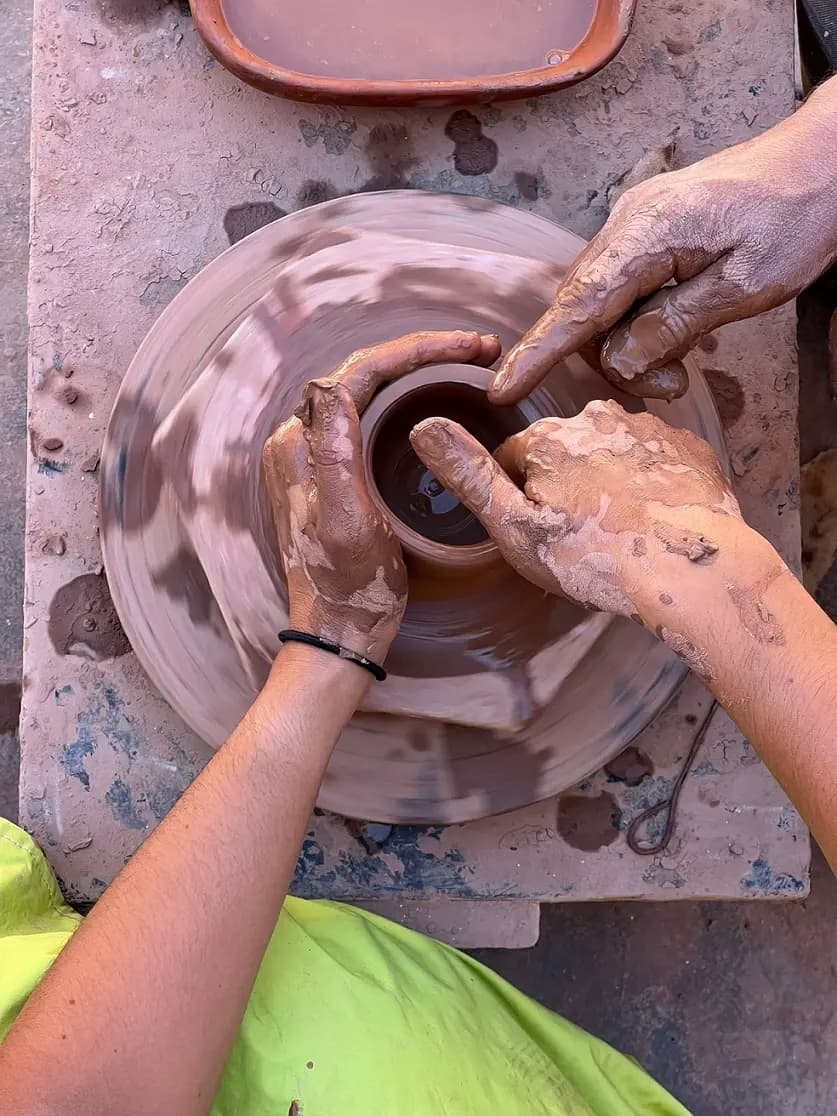 Things to do in Agadir
Pottery Workshop in Agadir: Make 3 Pieces with an Artisan
Pottery workshop at Kasbat Souss, Agadir, 1.5 hours with Moustapha, a potter with 20 years of experience: create 3 pieces on the wheel using local clay, starting at €35. Small group, ages 8 and up.
Discover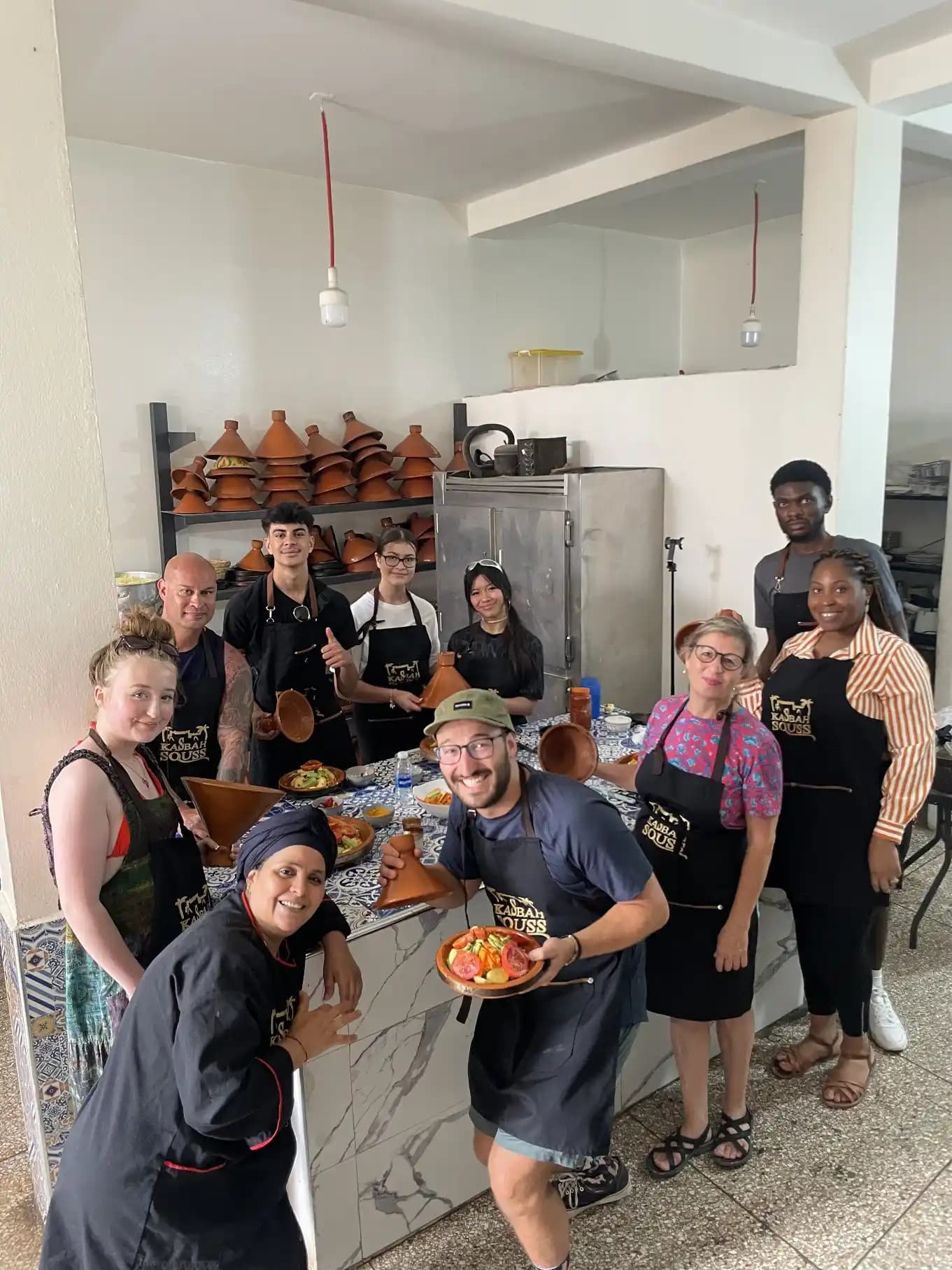 Cooking classes in Agadir
Agadir Kasbah Cooking Class with Chef Salma
Agadir Kasbah Cooking Class with Chef Salma: visit to the local market, choice of tagine, and lunch at a traditional restaurant. Transport included. €35 per person.
Discover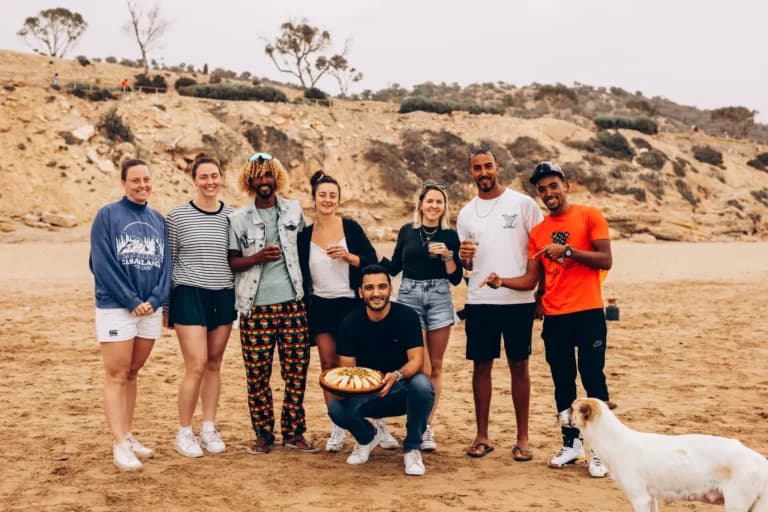 Cooking classes in Agadir
Taghazout Cooking Class: Tagine on the Beach at Sunset
Taghazout cooking class at sunset. Cuisine with our local chefs outdoors, then enjoy your tagine overlooking the Atlantic at sunset. 3 hours, all levels.
Discover
Want to adjust the itinerary? Any questions?
Every tour can be tailored to your pace, your dates or your wishes. Write to us, we reply personally.