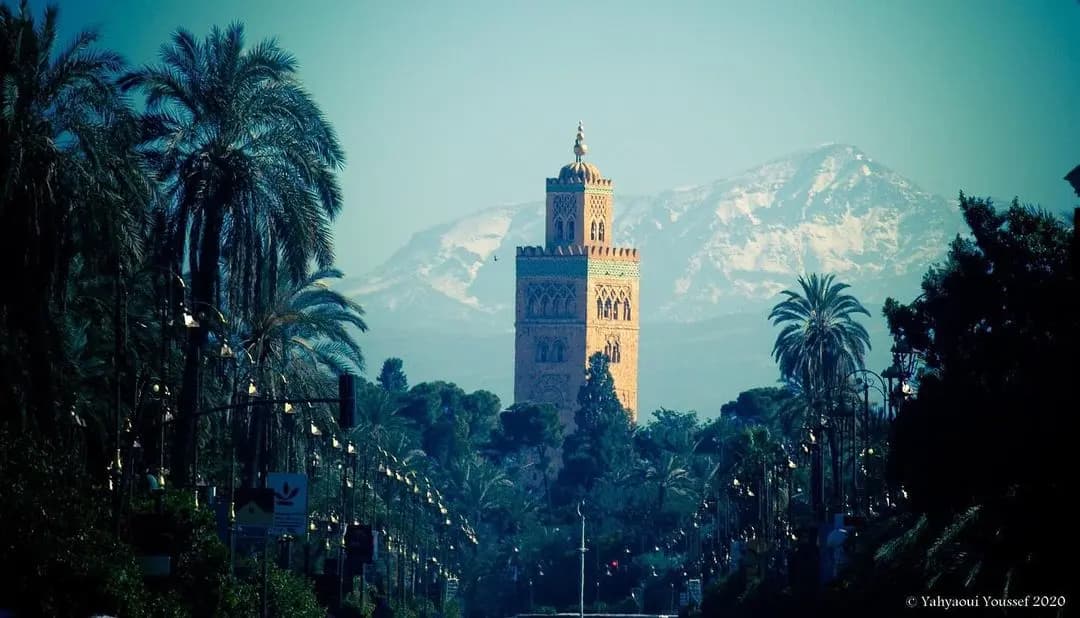
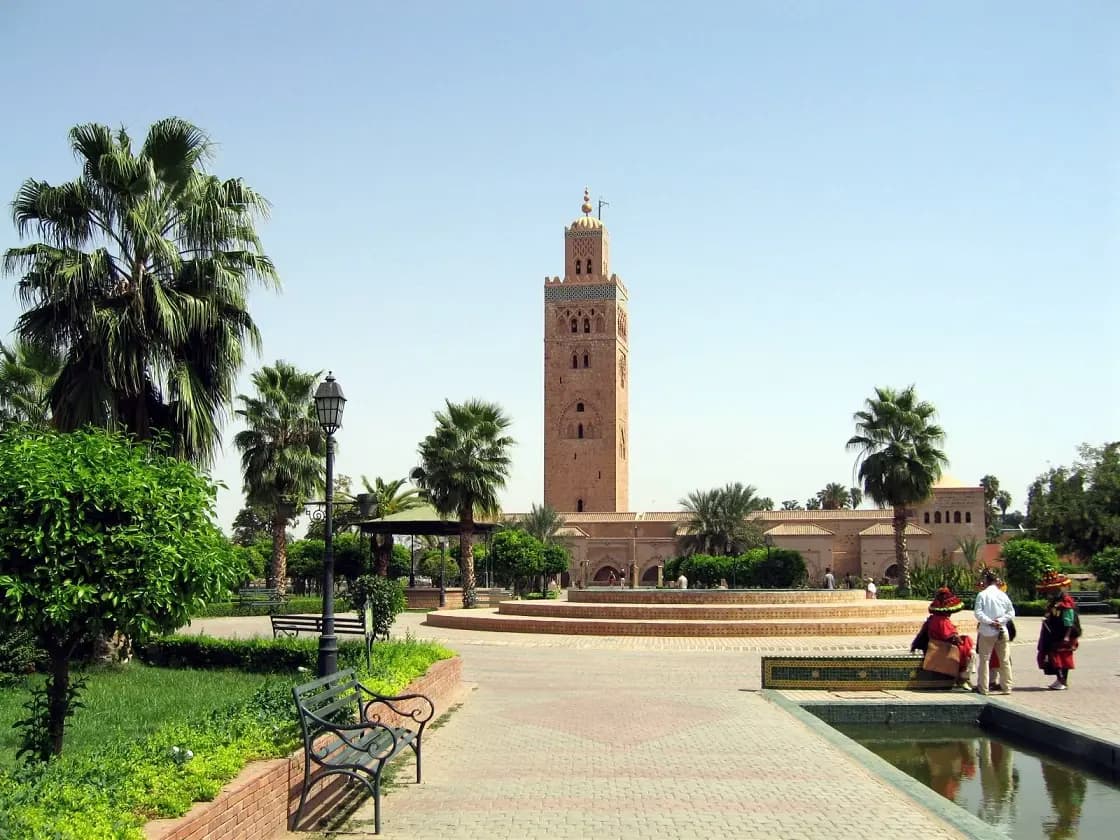
VisitKoutoubia mosqueis Marrakech's largest monument and its absolute landmark: its 77-metre Almohad minaret dominates the medina, visible from almost anywhere, just a stone's throw from Jemaa el-Fna square. Many visitors arrive expecting to "visit" it, only to leave surprised: the interior is reserved for Muslims. But the esplanade, gardens and silhouette of the minaret are well worth the detour, free of charge. Here's our 2026 guide: what you can actually see, the history of the monument, and where to photograph it.
Infos pratiques
Is it possible to visit the interior of the Koutoubia mosque?
No, you can't visit the inside of the Koutoubia mosque: access is reserved for Muslims, as in most active mosques in Morocco. However, the esplanade and gardens are open to visitors free of charge, and the 77-metre minaret can be admired from all angles. It's one of Marrakech's finest vantage points, especially at sunset, and the landmark that will guide you throughout the medina. So there's no need to look for a ticket: there aren't any, and there's no access to the top of the minaret either.
A prohibition that does not stem from religion
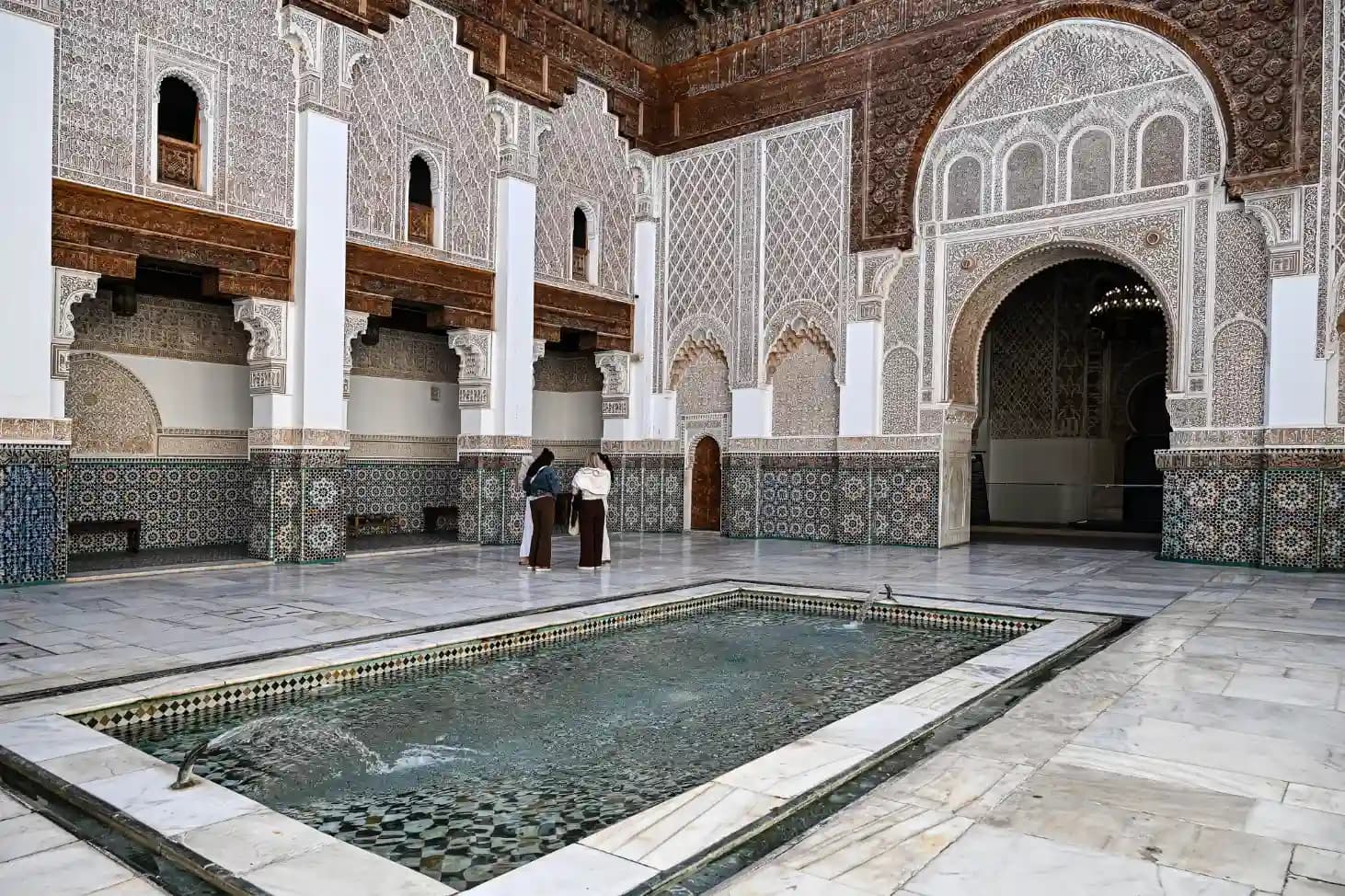
Contrary to popular belief, the ban on non-Muslims entering Moroccan mosques does not derive from Islamic law, but from a decree dating back to the time of the French protectorate, introduced to preserve the sanctity of places of worship and prevent unrest. This rule, originally intended by the Resident General Lyautey, remained in force after independence and applies to almost all active mosques in the country. There are a few exceptions, such as the Grand Mosque Hassan II in Casablanca, which can be visited with a ticket, or certain disused medersas like the Medersa Ben Youssef; but the Koutoubia, a working mosque, is not one of them. Knowing this avoids disappointment and helps you to calibrate your visit: you don't come to enter, you come to contemplate and understand.
What you can see and do for free
Even without going inside, there's plenty to keep you busy around the mosque. The minaret can be seen from every angle as you walk around the esplanade, and each face offers a different setting. The gardens to the south offer a welcome spot of shade and coolness after the hustle and bustle of Jemaa el-Fna, with benches to take a breather. Here's what you can do:
- Admire the minaret up close, with its patterned stone and brick facades and four golden balls at the top.
- Stroll through the Koutoubia gardens, planted with rose, orange and olive trees, with paths and ponds.
- See the archaeological remains of the first mosque, excavated on the northern esplanade.
- Listen to the call to prayer, which resounds five times a day from the minaret.
- Photograph the silhouette at sunset, when the stone takes on a coppery hue.
- Enjoy a shady bench in the gardens, a welcome break between two visits to the medina.
Many travelers start or end their day at the Koutoubia, simply because it's impossible to miss: wherever you go in the center, the minaret reappears above the rooftops and serves as a compass. That's why we recommend that you take a good look at it, at least once, rather than just walking through it.
Schedules, prices and length of visit to the Koutoubia
There are no tickets or opening hours for the exterior: the esplanade and gardens are freely accessible, day and evening, and the monument is illuminated at night. The area around the monument may be quieter or restricted during the five daily prayers, especially the Friday noon prayer, when large numbers of worshippers are present. Visits are entirely free, and in fact this is one of the few major sites in Marrakech that costs nothing at all.
Five times a day, the call to prayer rings out from the top of the minaret and spills over the medina: a highlight to experience if you're passing by, especially at sunset. The Koutoubia remains above all a living place of worship, not a museum; respect for this dimension is part of the visit.
How long will it take to visit the Koutoubia mosque?
Let's be honest: the Koutoubia mosque is a stopping-off point, not a half-day trip. Allow 15 to 30 minutes to walk around the minaret, through the gardens, observe the remains of the first mosque and take a few photos. It's a site you'll come across again and again during your stay, rather than a stage in its own right, especially as it's on the way between Jemaa el-Fna and most of the other monuments. So there's no need to block off a morning: make it part of a walking itinerary in the medina, and treat yourself to a second visit at dusk, when the lighting highlights the minaret. Paradoxically, this free and flexible service makes it one of the easiest sites in Marrakech to enjoy, provided you arrive with the right expectations.
The Koutoubia minaret, an Almohad masterpiece
The minaret, 77 metres high to the tip of its spire (69 metres for the tower alone), is a model of Almohad art. Its sober, powerful silhouette, in Guéliz stone and brick, is enlivened by bays, poly-lobed arches and a large turquoise ceramic frieze near the top. The sebka, a diamond-shaped network of decoration, runs along the facades, and each of the four faces has a different composition, so that the minaret never looks quite the same from one angle to the next. Inside, a gently sloping ramp, rather than a staircase, used to allow visitors to ride up to the top for the call to prayer.
The spire is crowned by four golden copper balls of decreasing size, which, according to local legend, are made of pure gold melted from the jewels of a sultan's wife. Built to call for prayer and assert the power of the Almohad dynasty, which then ruled the whole of the Maghreb and Andalusia, the minaret has survived more than eight centuries almost intact, and still serves as a model for modern mosques in Morocco.
Who built the Koutoubia mosque and when?
The Koutoubia mosque was built by the Almohad dynasty in the 12th century. The first mosque was commissioned around 1147 by Caliph Abd al-Mumin, founder of the dynasty, shortly after the capture of Marrakech from the Almoravids. The Almohads, who came from the Atlas Mountains, wanted to mark their capital with a monument worthy of their empire, which stretched from Portugal to Libya. The minaret we admire today was completed at the end of the 12th century, under the reign of Yacoub el-Mansour, around 1195-1199, at the height of the dynasty. It is thus a monument over eight hundred years old, strictly contemporary with the great European Gothic cathedrals, and one of the rare Almohad buildings to have survived intact.
Why "Koutoubia"? The booksellers' market
The name comes from the Arabic "koutoubiyyine", the booksellers: the esplanade was once home to a major book and manuscript market, at a time when Marrakech was a hotbed of learning and books were copied by hand. It is said that there were around a hundred book dealers. The booksellers' mosque has kept this name, even though the trade has long since disappeared; it's one of those toponyms that preserve the memory of a forgotten trade.
The double mosque and the enigma of the qibla
Little-known detail: there were two successive mosques on the site. The first, judged to be poorly oriented in relation to Mecca, was doubled by a second, realigned a few degrees to the south, after which the old one was abandoned. The foundations of the first mosque are still visible on the esplanade, north of the minaret: a rectangle of levelled walls and column bases that most passers-by ignore, and which tell the story of this correction of the qibla. Take two minutes to observe them: it's one of the few places where you can touch Almohad archaeology in the open air, free of charge. As for the minaret, it was preserved and attached to the new mosque, which explains why it is a little out of line with the present building.
Koutoubia, Giralda and Hassan Tower: the three Almohad sisters
If the minaret reminds you of something, it's normal. The Almohads built three great minarets at the same time, according to the same model: the Koutoubia in Marrakech, the Hassan Tower in Rabat (which remained unfinished for lack of funds after the death of Yacoub el-Mansour) and the Giralda in Seville (which became the cathedral's bell tower after the Reconquista, topped by a Renaissance campanile). The Koutoubia, the oldest and best-preserved of the three, probably served as a model for the other two. To compare them is to see at a glance the ambition of an empire that reigned on both sides of the Strait of Gibraltar, and to measure the extent to which the art of Marrakech reached as far as Spain. For many art historians, this trio is one of the pinnacles of medieval Mediterranean architecture.
Where and when to photograph the Koutoubia mosque?
This is undoubtedly the most photographed area of Marrakech, and a few pointers will help you get the right shots:
- In the late afternoon, around 5pm-7pm depending on the season, the low-angled light gives the minaret a warm, golden hue.
- From the Koutoubia gardens to the south, you can frame the minaret with rosebushes and palm trees in the foreground.
- At nightfall, the illuminated minaret stands out against the sky: a classic from Jemaa el-Fna Square.
- Remember to include horse-drawn carriages or palm trees to give scale.
Avoid midday, which is hard and flat; prefer the morning or late afternoon, when the light sculpts the relief of the minaret.
For an unobstructed view of the whole minaret, step back towards Avenue Mohammed V or sit in the gardens: too close and the height will overwhelm the frame. And if you're looking for a postcard photo, the combination of the illuminated minaret and the bustling Jemaa el-Fna in the background, just after sunset, remains the most spectacular. Remember to respect the tranquility of the setting and the discretion of the worshippers on their way to prayer.
What to do around the Koutoubia mosque
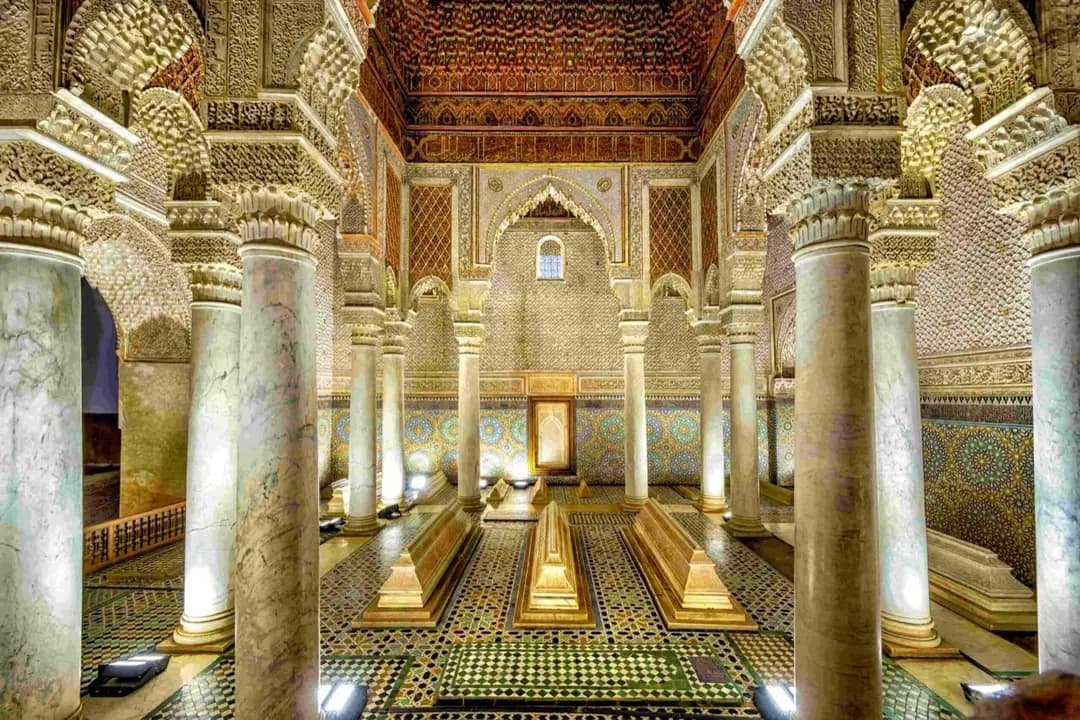
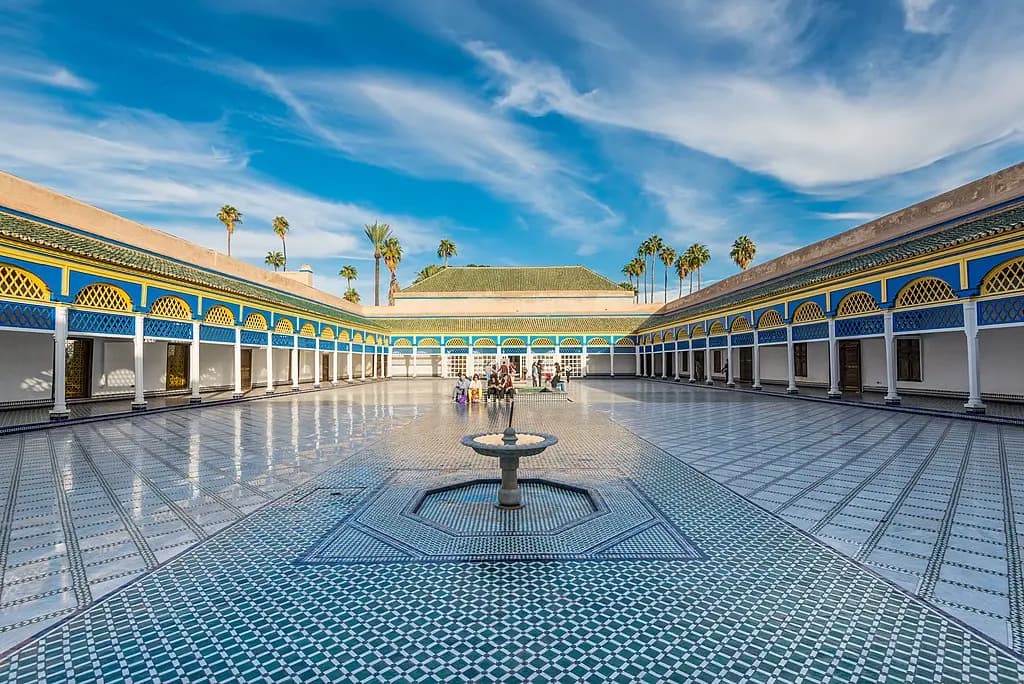
The Koutoubia's strength lies in its position: it is the hub of the historic center, and most visits to Marrakech pass through it, almost in spite of themselves. Visitplace Jemaa el-Fnais about 200 metres, or a five-minute walk, and from there it's easy to reach thesouksto the north, or, to the south, theBahia Palaceandsaadian tombs. TheBen Youssef medersaThe Koutoubia is located further north in the medina. The best thing to do is to make the Koutoubia part of a walking loop: walk along it from one monument to the next, stop for a few minutes in the gardens, and come back to see it illuminated in the evening. There's no need to set aside a special time: it's the natural thread that runs through a day in the medina.
To organize the rest of your stay, see our guidewhat to do in Marrakechand theMarrakech city page. And if you're interested in Almohad art and Moroccan craftsmanship, why not extend your visit with azellige workshop in Marrakechto get an insider's view of the motifs found on the city's major monuments.