VisitBen Youssef medersais the largest old Koranic school in Morocco, located north of the Marrakech medina, next to the Ben Youssef mosque. Reopened in 2022 after four years of restoration, it boasts a marble courtyard with a pool, walls entirely covered in zellige, carved stucco and cedar, and 132 student cells spread over two floors. Here's our 2026 guide: ticket prices, opening times, what you can see, its history, and how to avoid the crowds to get the most out of it.
Infos pratiques
Is the Ben Youssef medersa worth the effort since its renovation?
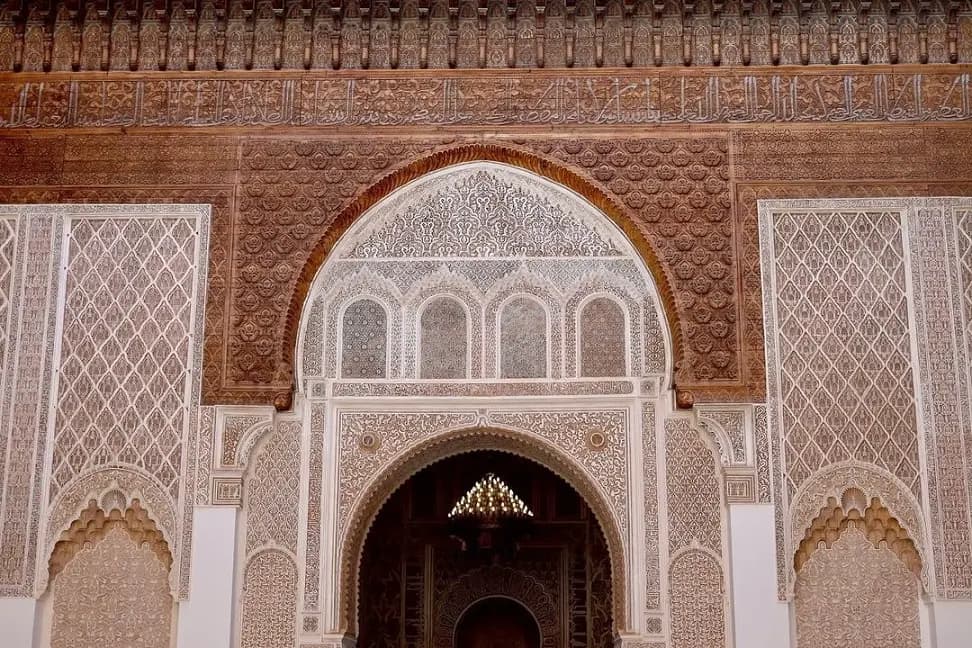
Yes, the Ben Youssef Medersa is well worth a visit, and even more so since its renovation. It's one of Morocco's finest examples of Islamic architecture: a marble courtyard framed by galleries covered in zellige, finely chiselled stucco and carved cedar wood of rare density. Two honest drawbacks. First, the place is empty: you're visiting architecture and décor, not a museum of artifacts or a working school. Secondly, the courtyard has become very popular with photographers, and fills up quickly from 10:30 onwards, making it difficult to get shots without people. Our advice: arrive as soon as the courtyard opens at 9 a.m., allow 45 minutes to 1h15 for the visit, and go upstairs to the cells for the best views over the courtyard.
Who's it for: lovers of architecture, crafts and photography, and all those who want to understand how knowledge was passed on in the Morocco of yesteryear. The entrance fee is modest in relation to the beauty of the place, making it one of the best value for money in the medina.
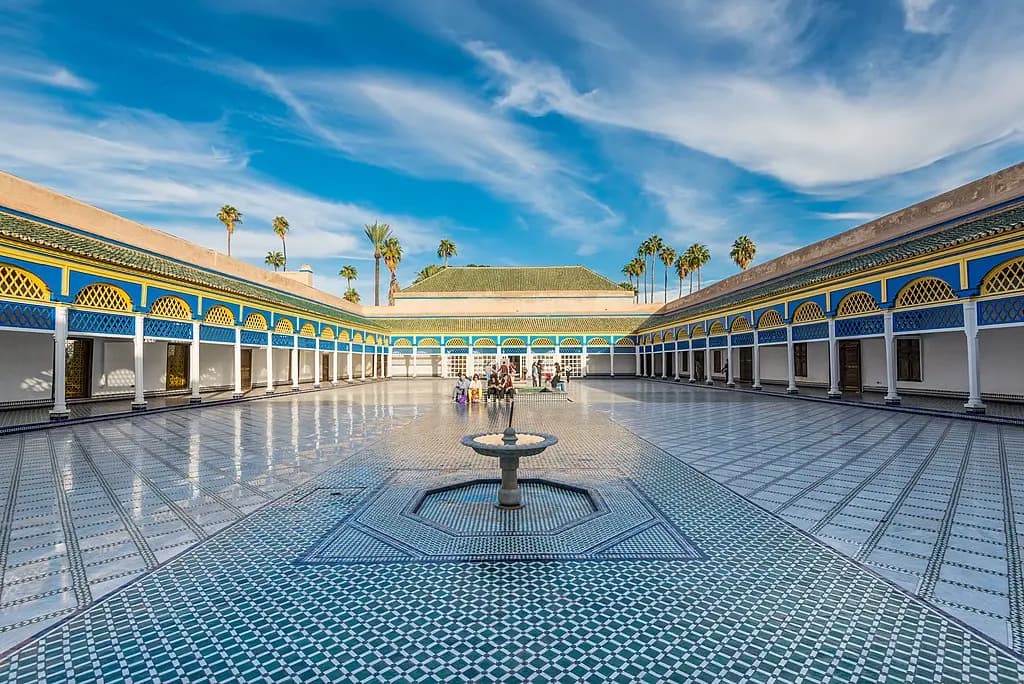
Compared to the city's palaces, the visit has a different flavor: where the Bahia Palace recounts the power and splendor of the 19th century, the medersa speaks of transmission, study and spirituality. It's also a more concentrated setting: all the genius of the craftsmen fits into a single courtyard, making it a compendium of Moroccan Islamic art. Many visitors cite it as their most pleasant surprise in Marrakech, precisely because you wouldn't expect such decorative density behind a discreet façade.
What the renovation of the Ben Youssef medersa has changed
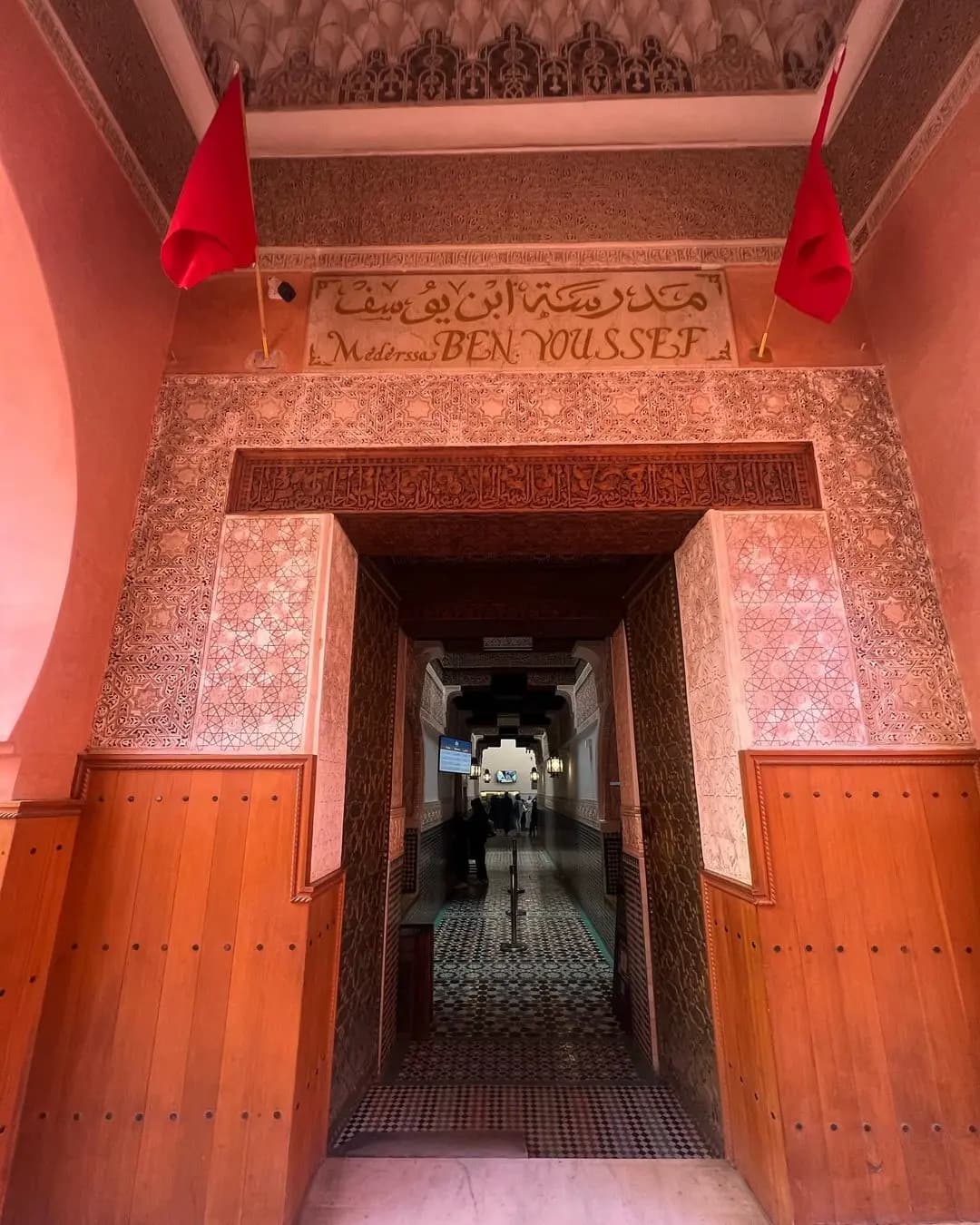
Closed to the public from 2018 to 2022 for a thorough restoration, the medersa reopened in spring 2022. Craftsmen took up the missing zelliges piece by piece, consolidated the cedar woodwork weakened by the centuries, cleaned the stuccoes and resealed the building, all using traditional techniques. The result is dazzling: the colors of the mosaics stand out, the Koranic inscriptions can be read again, and the tour route, better organized and accompanied by a few explanatory panels, leads logically from the entrance to the courtyard, then to the prayer room and the cells. If you've visited the medersa before it closed, you'll find it much improved; and if it's your first time, you'll discover it in the best condition it's been in for a long time.
Entrance fees and opening hours for the Ben Youssef Medersa in 2026
Admission to the Ben Youssef Medersa is not free, but the price is reasonable. Tickets can be purchased at the entrance ticket office.
How much does a ticket to the Ben Youssef Medersa cost?
Here is the tariff schedule for 2026:
- Foreign adult: DH50 (approx. €5)
- Resident in Morocco, upon presentation of CIN or residence permit: 20 DH
- Children under 12: DH10
- Group (21 people or more): DH30 per person
- Audioguide (optional): approx. 30 DH
These prices are subject to change; check the amount displayed at the ticket office. The ticket does not have to be combined with other monuments, but the medersa can be visited in the same half-day as the neighboring Ben Youssef Mosque and the Marrakech Museum.
Opening hours, length of visit and best time to visit
The medersa opens every day, generally from 9am to 7pm, with shorter hours during Ramadan (often 9am-4.30pm). The last entrance is a little before closing time. Allow 45 minutes to 1h15 for a leisurely visit. The best time is undoubtedly first thing in the morning, from 9am: the courtyard is calm, the morning light glides over the zelliges, and you can photograph the pool without the mid-morning crowds.
What to see inside the medersa
The itinerary is simple: you enter via a decorated corridor and vestibule, which create a sense of surprise, you enter the large courtyard, then visit the prayer room at the far end and the cells on the upper floor. Each stage is well worth a visit, and the direction of the tour has been signposted since the renovation. Take your time: the beauty of the medersa lies as much in the overall view as in the details, and it's sometimes necessary to stop for a long time in front of a stucco panel to grasp its finesse.
The courtyard with its basin and the Saadian décor
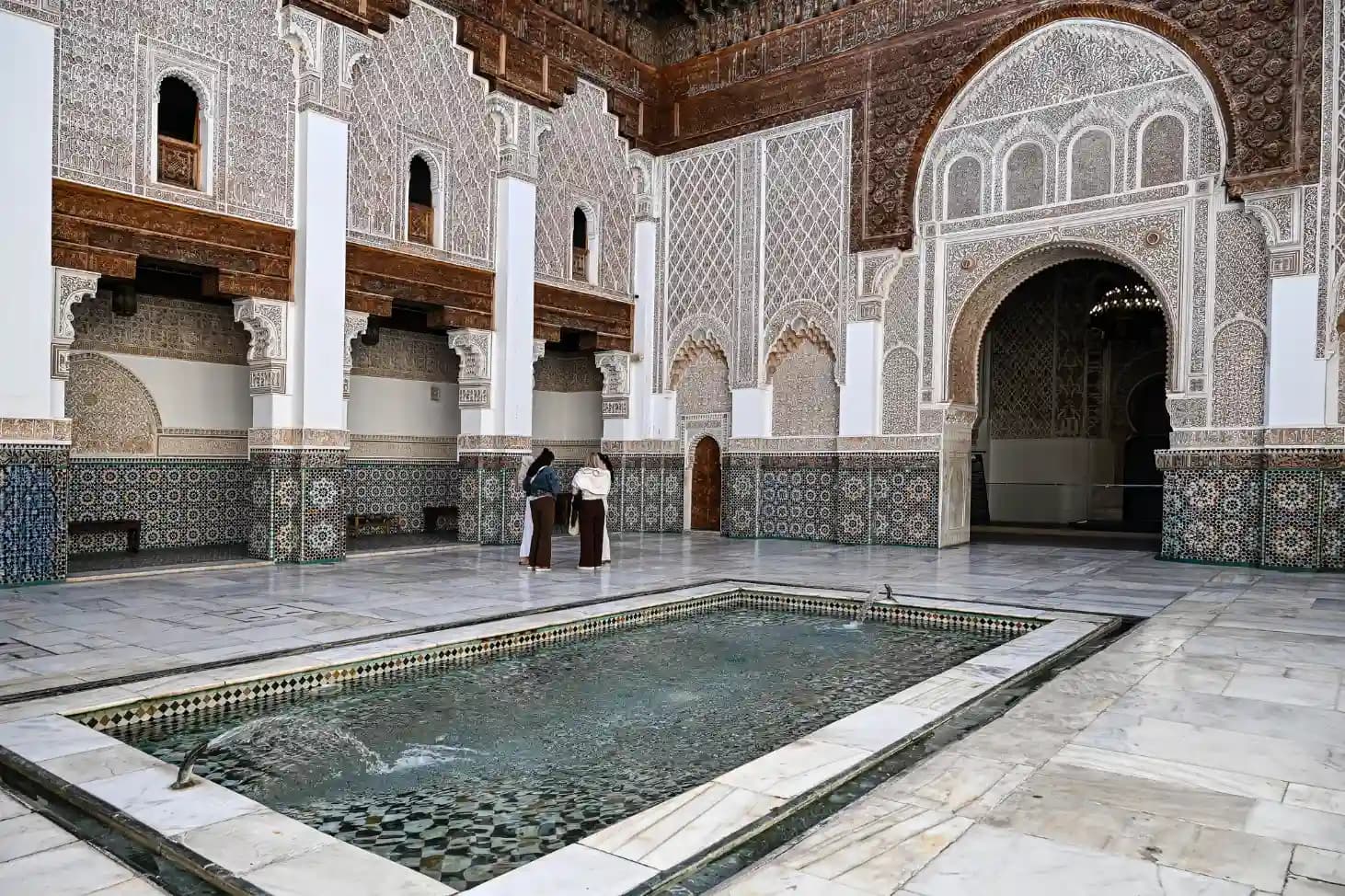
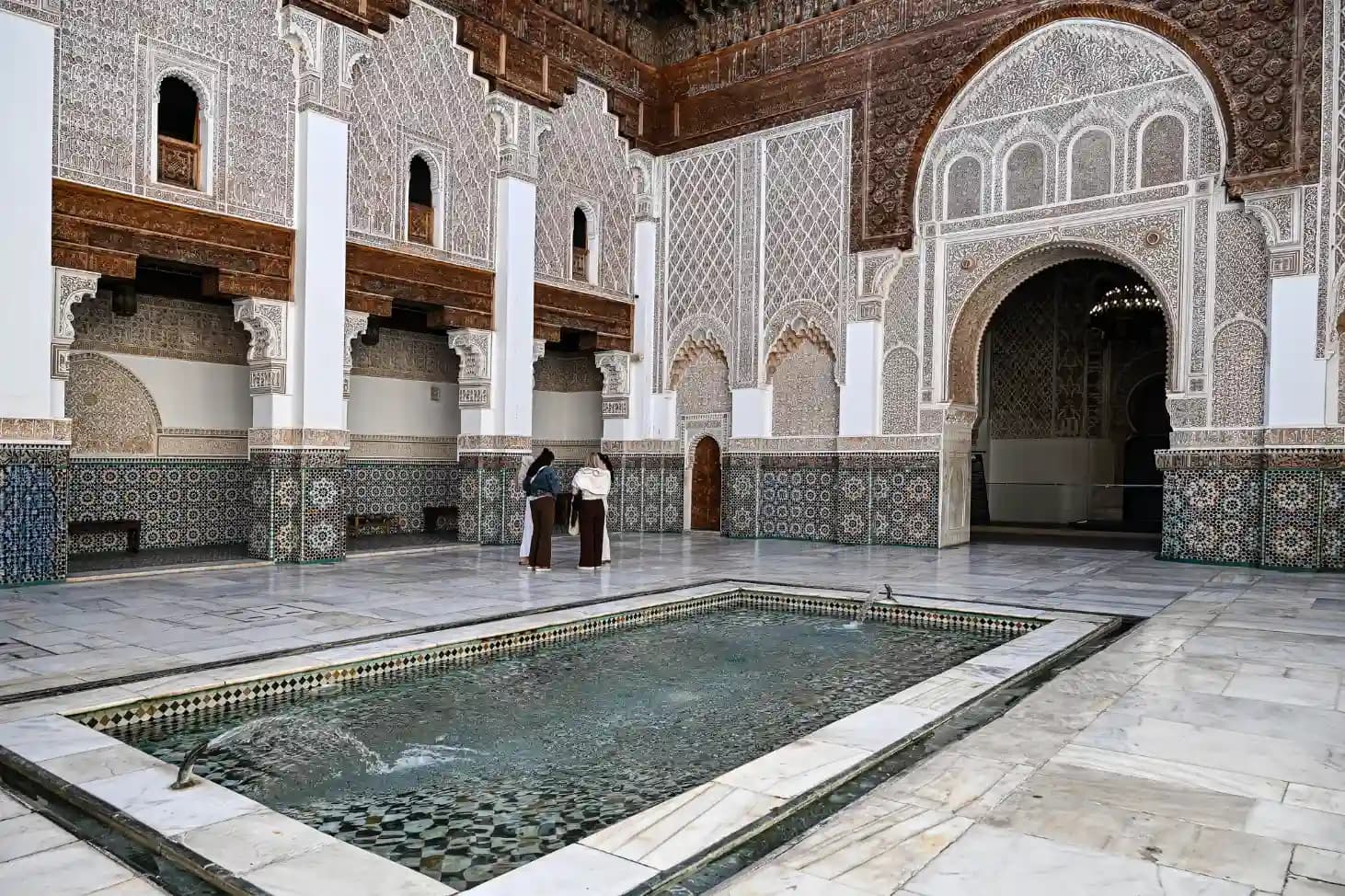
The courtyard is the highlight of the visit: a large rectangular patio paved in marble, with a central pool that reflects the galleries, and which you cross like a courtyard of light. The walls display the three materials of Moroccan decorative art, tiered from floor to ceiling. At the bottom, zellige (ceramic mosaic) forms geometric friezes in deep colors. Above, a wide band of stucco (gebs), carved with floral motifs, interlacing and Koranic inscriptions in kufic and cursive, impresses from close up. Finally, cedar wood, carved and sometimes painted, crowns the ensemble: lintels, corbelled awnings, doors and coffered ceilings. This decorative grammar can be found throughout the medersa, in an infinite number of variations, never exactly repeated.
At the far end of the courtyard, the prayer room opens through an archway, featuring a finely decorated mihrab facing Mecca, marble columns and a cedar dome. This is the most solemn area of the site. Look up systematically throughout the medersa: the cedar ceilings are among the most beautiful in Morocco, and it's often here that the most meticulous work is hidden.
The 132 student cells
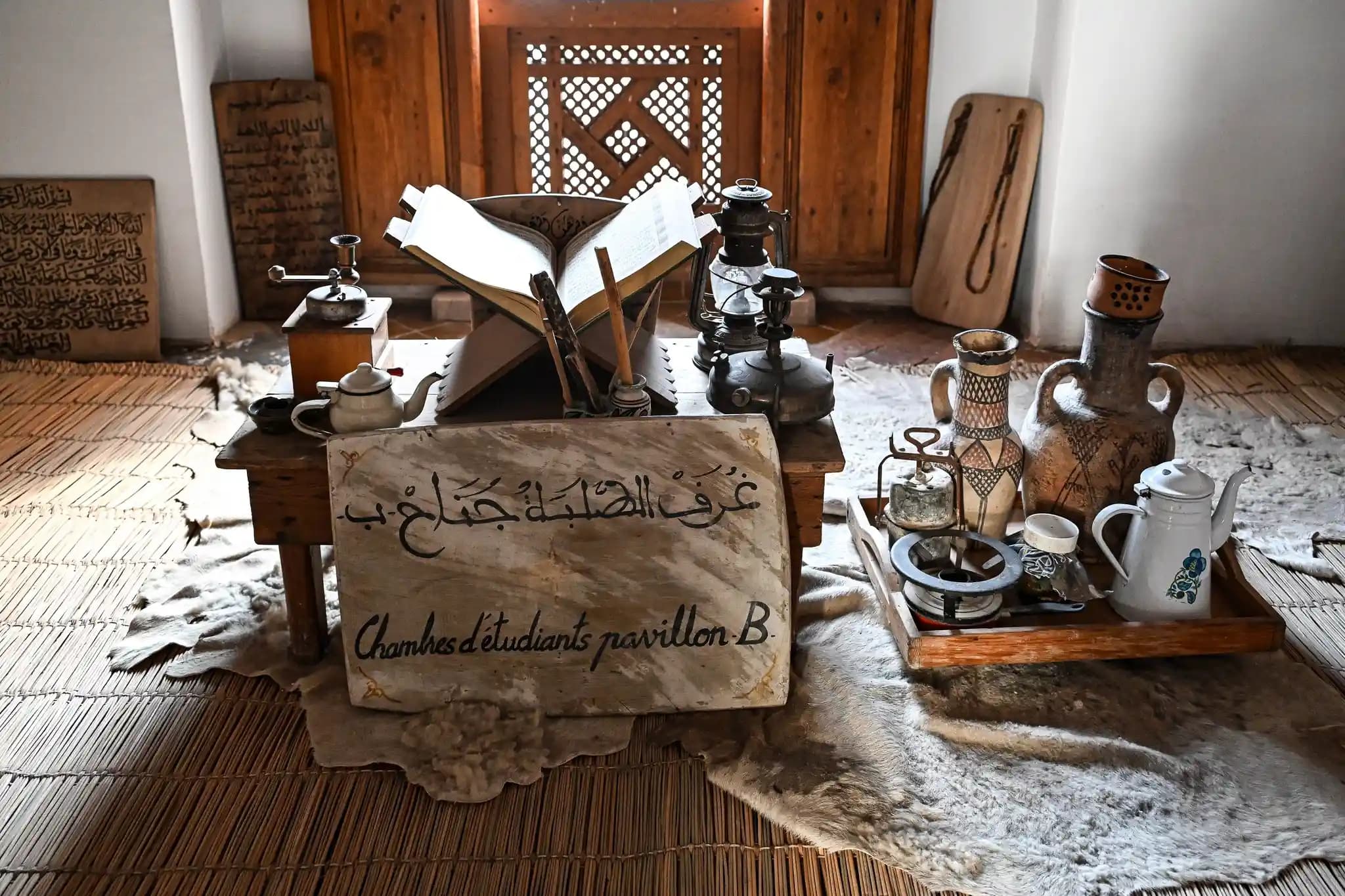
Upstairs, a maze of small, austere rooms encircles the courtyard: these are the 132 cells that housed the students, sometimes several hundred at a time, who came from all over Morocco and beyond to study the Koran, law, grammar and religious sciences. Tiny, often with no windows to the outside, lit by moucharabiehs or small openings onto the courtyard, they offer a striking contrast with the richness of the first floor décor: here, the simplicity of studious asceticism; below, the splendor of the courtyard. Some of the cells are distributed around small secondary patios, which aired and lit up the upper floor. Walking through these passageways, you can imagine the daily life of the taleb (students), between classes, prayer and study. The balustrades on the second floor offer the best views of the pool, the galleries and the prayer room.
History of the Ben Youssef Medersa: from the Marinids to the Saadians
The history of the Ben Youssef Medersa can be read in two phases, separated by more than two centuries, and this is precisely the point that many tourist accounts confuse. Knowing its dual origins helps us understand what we're looking at: the function comes from the Marinids, the décor we admire today comes from the Saadians.
The Merinid foundation, circa 1350
The medersa was founded in the 14th century by the Marinid dynasty, great builders of Koranic schools in Morocco, near the Ben Youssef mosque which gives it its name (from the Almoravid sultan Ali ben Youssef, founder of the mosque in the 12th century). It is part of a vast network of medersas created by the Marinids in Fez, Salé, Meknes and Marrakech to train the kingdom's religious, legal and administrative cadres. These institutions housed and fed deserving students free of charge, financed by pious foundations (habous): a form of medieval university that structured Morocco's intellectual life for centuries.
The Saadian reconstruction, 1564-1565
Two centuries later, the Saadian sultan Abdallah al-Ghalib had the medersa completely rebuilt and enlarged in 1564-1565, just as Marrakech was regaining its status as the capital. The decor and proportions we admire today date from this campaign: the medersa could now accommodate several hundred students and was the largest in Morocco. The best craftsmen, trained in the schools of Andalusia and Fez, worked for years on marble, stucco and cedar. The medersa functioned as a Koranic school until 1960, when it was closed, restored and opened to visitors. Contrary to what some guidebooks write, it was not the Saadians who founded it, but the Marinids: the Saadians rebuilt it magnificently. This precision is one of the markers that distinguish a reliable account from a cut-and-paste one.
Avoid crowds and get the best shots
The medersa is one of the most photographed places in Marrakech, and the courtyard can quickly fill up. To enjoy it in peace and quiet :
- Arrive as soon as it opens at 9 a.m., before groups and cruise passengers.
- Avoid mid-morning (10:30am-1pm), the busiest time of day.
- Go upstairs first: the passageways offer plunging views over the courtyard, often less crowded than the first floor.
- Visit on weekdays rather than weekends if you can.
- Wait a few minutes: between two groups, the courtyard sometimes empties completely for the time of a shot.
- Use a wide-angle lens to capture the entire courtyard, and expose for the dark zelliges rather than the sky, otherwise the walls will come out too dark.
Last but not least, the medersa is an ancient place of worship and a respected monument: proper attire is recommended, as is discretion in the prayer room. The calm of the morning is all the more precious for experiencing the atmosphere of study that has reigned here for centuries.
How to get there and what to see
The medersa is located in the Kaat Benahid district, in the north of the medina, about ten minutes' walk from the main square.place Jemaa el-Fnathrough thesouks. There's no access by car to this part of the medina: you can get there on foot, or by small cab that drops you off at the entrance to the district. The journey from Jemaa el-Fna is part of the experience, through the narrow shopping streets; remember to bring an off-line map, as signage is limited.
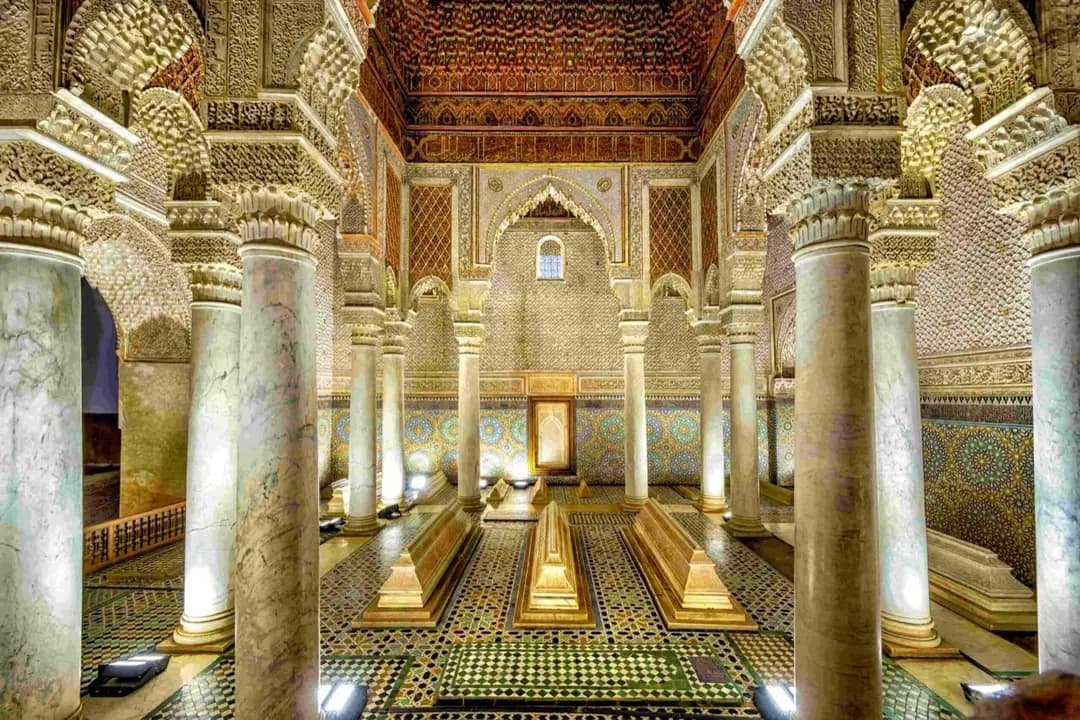
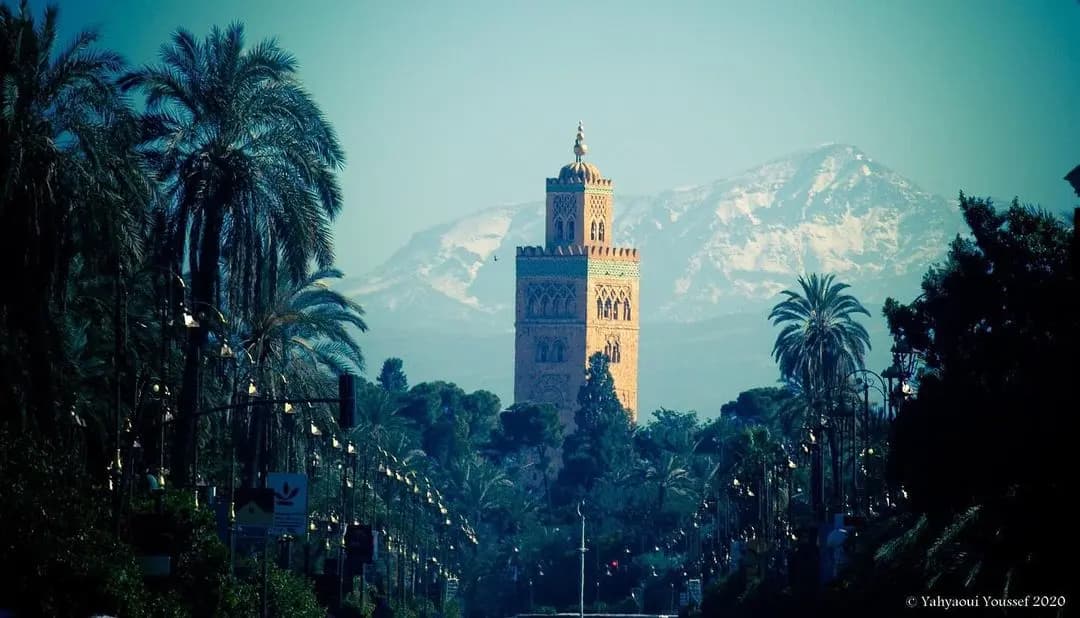
There are several sites to visit in the same half-day. The medersa adjoins the Ben Youssef mosque, from which it takes its name, and the Almoravid Koubba, a small 12th-century pavisson, one of the few Almoravid remains in the city and an architectural gem. The Marrakech Museum, housed in a former palace next door, completes the visit with its collections and patio. Combine these three or four stops and you've got a complete, coherent morning in the northern medina.
To organize the rest of your stay, see our guidewhat to do in Marrakechand theMarrakech city page. And if you're fascinated by the zelliges and stucco of the medersa, understand the gestures that produce them by booking a guided tour of the medersa.zellige workshop in Marrakechor apottery workshop. On the south side of the medina, continue with theBahia Palaceandsaadian tombsto measure the decorative continuity between these great Marrakech monuments.