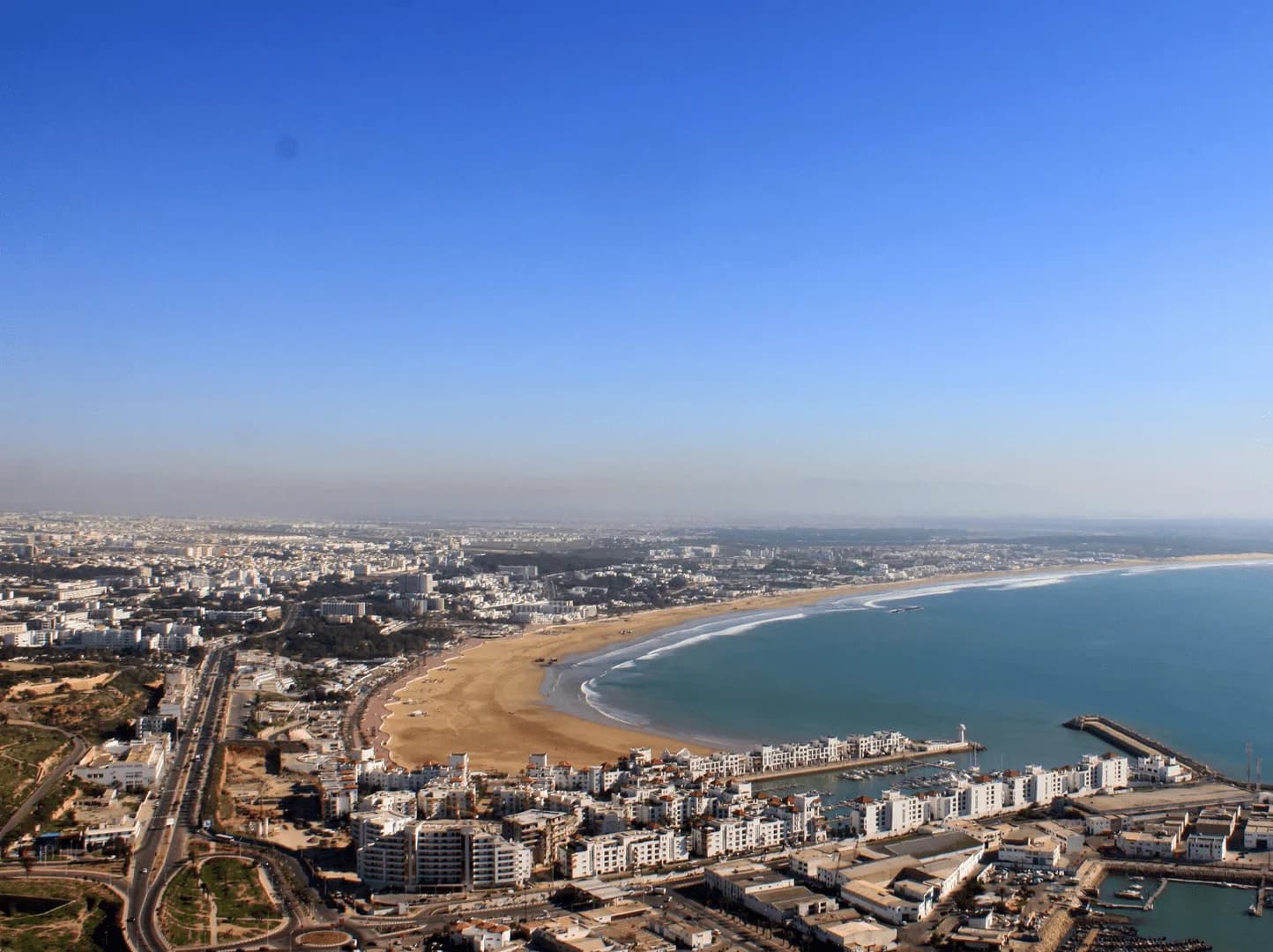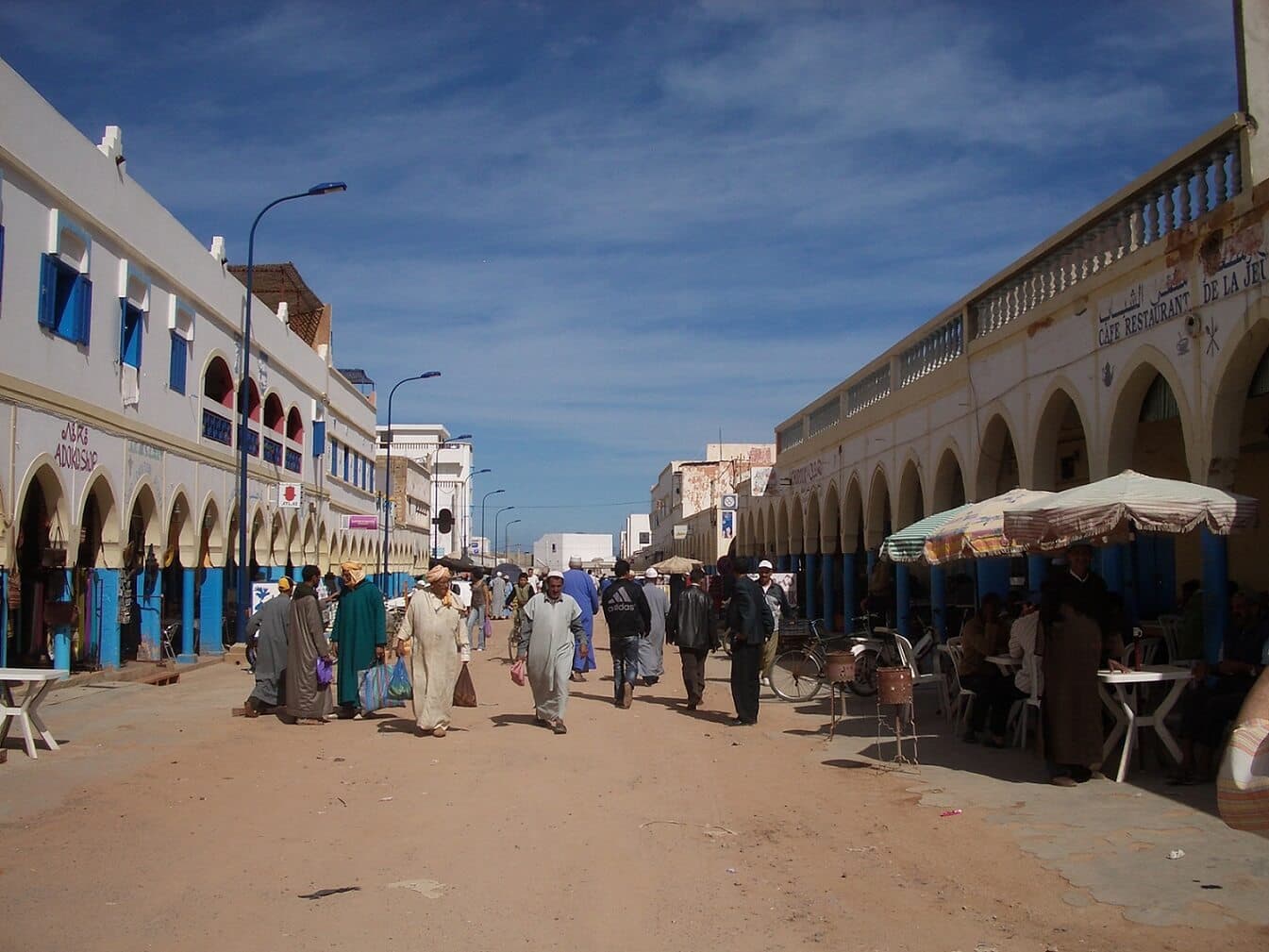
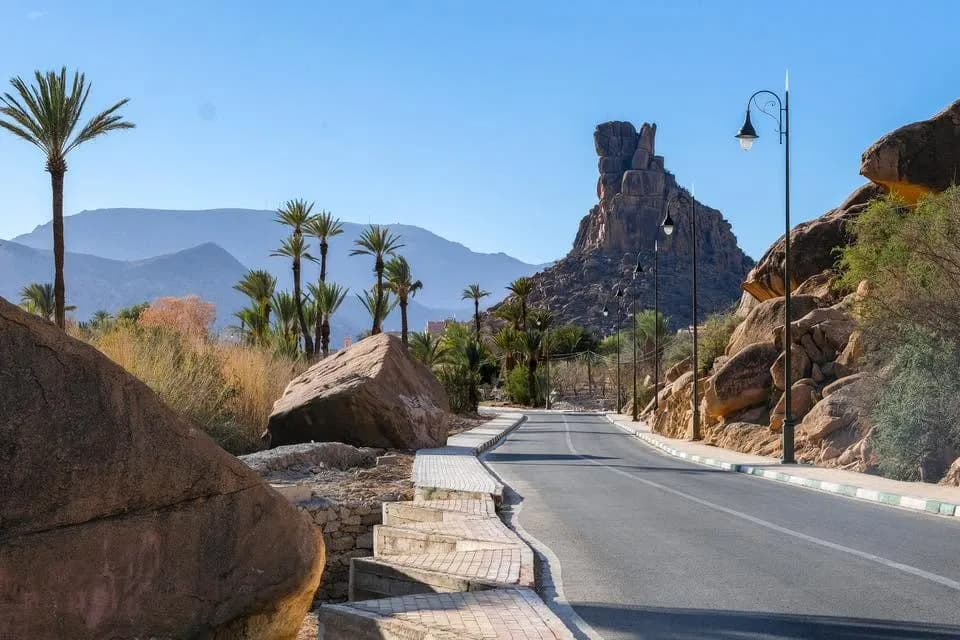
Tafraoute rises at an altitude of 1,000 meters, after a 160-km drive from Agadir and one final mountain pass: a cirque of pink granite, ochre-colored villages. It really climbs. The curves grow tighter, the asphalt wears thin, and the scenery shifts dramatically. At every hairpin turn, you see argan trees give way to olive trees, then to almond trees.
At an altitude of 1,000 meters, you cross one last mountain pass, and the landscape bursts into view: a vast cirque of pink granite, ochre-colored villages clinging to the slopes, palm groves at the bottom of the basin, and an almost surreal calm. You’ve just arrived in Tafraoute. Not a city, not quite a village: a rocky oasis in Morocco’s Anti-Atlas Mountains.
Practical Information
Why Tafraoute Is Worth the Detour from Agadir or Marrakech
In Morocco, there are landscapes you simply pass through, and others you make your home in. Tafraoute belongs to the latter category. Nestled in a basin of pink granite about 160 kilometers southeast of Agadir and 340 kilometers south of Marrakech, the town is an ideal base for exploring the Anti-Atlas, a mountain range gentler and more colorful than the High Atlas that borders it to the north.
What immediately strikes you is the light. The granite that makes up the surrounding peaks turns pale pink in the morning, orange-red at noon, and deep mauve at dusk. The landscape literally changes color every two hours. Both professional and amateur photographers find photo opportunities here that few other places in Morocco offer.
The other unique feature is the culture. Tafraoute is the heart of the Ammeln region, a confederation of Berber tribes that inhabit 26 villages clinging to the valley of the same name. This region has long been a source of emigration to Morocco’s major cities and Europe: many of Morocco’s grocery store owners come from here.
Families have prospered elsewhere, but they return. And this constant back-and-forth has made the Ammeln villages a surprising blend of Berber tradition and understated modernity.
Tafraoute, finally, is the antithesis of Marrakech. No frenetic souks, no touts, no traffic. A large, shaded square, a few cafés, a weekly market, and silence. If you’re looking for a place to slow down, you’ve come to the right place.
Places to See in Tafraoute and the Surrounding Area
Jean Vérame’s painted rocks in Tafraoute
The region’s most famous artwork. In 1984, Belgian artist Jean Vérame, accompanied by a team of Moroccan firefighters, covered several dozen granite boulders with 18 metric tons of blue, red, mauve, and violet paint. A monumental land art installation, dedicated to his late wife, that spans 1.5 hectares, 3 kilometers south of the village of Aguerd Oudad.
The colors have faded significantly over the past forty years (the artwork hasn’t been repainted in a long time), but the overall effect remains impressive. The contrast between the faded pigments and the pink granite, the bright blue sky, and the ochre peaks in the background makes it one of the most photographed sites in the Anti-Atlas.
Access is unrestricted, free, and possible on foot (1 hour from Tafraoute) or by car (10 minutes). Combine your visit with the nearby rock formation known as “Napoleon’s Hat,” a granite boulder that bears a striking resemblance to a military bicorne hat.
The Ameln Valley around Tafraoute: 26 villages
This is the authentic heart of the region. The Ameln Valley stretches north of Tafraoute, at the foot of the massive Jbel el Kest cliff (2,359 meters). As you travel from village to village, you’ll explore one of Morocco’s most beautiful concentrations of traditional Berber architecture: ochre adobe houses, dry-stone terraces, and hand-tended palm groves.
A few key villages to visit:
- Oumesnat: famous for its Traditional House, which has been converted into a small museum of Berber arts and traditions (admission 20-30 dirhams).
- Tirnmatmat: a spectacular palm grove, accessible via a pleasant little trail.
- Anameur: a classic starting point for hikes up Jbel el Kest.
- Tazka: known for its prehistoric rock engravings, an hour’s walk from the village.
The entire valley loop can be covered in half a day by car, but it takes two to three days to truly appreciate it on foot, staying at a Berber guesthouse.
The Aït Mansour Gorges
Located 30 kilometers southeast of Tafraoute, the Aït Mansour Gorges are one of the Anti-Atlas’s most beautiful surprises. Imagine a red granite canyon, carved by a seasonal wadi, whose floor has gradually transformed into an oasis. Date palms, argan trees, and oleanders-all at the foot of 100-meter-high cliffs.
The road leading down into the gorge is narrow but paved and accessible by passenger car in dry weather. Several Berber villages still line the route, and you can stop to buy fresh dates, share a cup of tea, or have a picnic in the shade of a palm grove. The entire loop takes half a day. This is an excursion you won’t want to miss if you’re staying in Tafraoute for more than a day.
The Wednesday Market
If possible, plan your visit for a Tuesday evening or Wednesday. Tafraoute’s large weekly souk is set up on the outskirts of town and brings together producers and buyers from across the region. It’s a chance to buy local argan oil, almonds, olive oil, jujube honey, and dates-and to experience Berber social life, which is harder to catch a glimpse of on other days of the week.
The Traditional House of Oumesnat
To understand what life was like in this region a century ago, stop for an hour at the Traditional House of Oumesnat. The owner, a descendant of the Ammeln family, will guide you through the rooms of the family home, which have been preserved in their original state: the Berber kitchen, the traditional living room, and the weaving workshop. Admission is 20-30 dirhams; sometimes you’ll even get a complimentary cup of tea.
When to Visit Tafraoute: The Best Seasons
The climate at an altitude of 1,000 meters is completely different from that of Agadir. Here’s how to plan your visit based on what you’re looking for.
February: The Almond Blossom Festival
The event you won’t want to miss. Every February, the blooming almond trees turn the Ameln Valley white and pink. The Almond Blossom Festival features Amazigh music, traditional dances, stalls selling local products, and tastings. This is when Tafraoute is at its liveliest and most beautiful-and also when it’s hardest to find a room without a reservation. Book two to three months in advance.
March-May: Ideal Spring Weather
Daytime temperatures range from 18 to 25 degrees, with cool nights (10-14 degrees) and often clear skies. This is the perfect season for hiking in the Ameln Valley, climbing the granite outcrops, and exploring on foot. The vegetation turns green again after the rains, and the first blooms (oleanders, wild roses) beautify the valleys.
September-November: Autumn Is Just as Beautiful
Mild climate, warm days, cool evenings. Fewer people than in the spring. The colors of the granite are at their peak, and almonds are harvested and sold at the markets. Excellent for hikers.
Summer (June-August): best avoided except at higher elevations
Temperatures in the Tafraoute basin can reach 38 degrees. The region is not suited for traditional summer tourism. If you visit in summer, set out early in the morning and opt for hikes at higher elevations.
Winter (December-January): Absolute tranquility
Tafraoute is very quiet during this season. Temperatures are cool (5 to 18 degrees), with occasional light snow on the peaks. Ideal for those seeking absolute silence, but be sure to pack warm clothes for the evenings.
How to Get to Tafraoute
From Agadir (160 km)
The most direct route: Agadir → Tiznit → Tafraoute via the N1 and then the R104. Allow 3 to 3.5 hours for the drive. The stretch from Tiznit to Tafraoute is breathtaking, with tight curves and nonstop panoramic views. It’s a drive worth taking your time to enjoy: don’t try to cover it in 2.5 hours-you’ll miss the best part.
An alternative route goes through Aït Baha and the Kerdous Pass: longer (180 km, 4 hours), but with even more spectacular scenery. This is the better option if you have the whole day.
From Marrakech (340 km)
Allow 6 to 7 hours by car via Taroudant and Tiznit. Too long for a day trip: plan to spend a night in Taroudant on the way there or back, and make the most of the journey.
By CTM or Supratours bus
Several daily departures from Agadir; allow 5 hours for the trip and about 100 dirhams per person. The Tafraoute bus station is a 10-minute walk from downtown.
On an organized tour
For those who don’t want to drive or who want a guide familiar with the Ameln villages, several tour operators offer 2-day/1-night trips to Tafraoute from Agadir, starting at 1,200 dirhams per person. This is the ideal option for exploring the region in depth.
Our tours departing from Agadir often include Tafraoute as part of an itinerary combining the “City of Silver” in Tiznit, the oases of the Ameln Valley, and the painted rocks.
Where to Stay and What to Eat in Tafraoute
Accommodations
The main attraction of Tafraoute is the opportunity to stay in an authentic Berber guesthouse. Several options are available to suit different budgets:
- Berber guesthouses in the Ameln Valley: 250 to 450 dirhams per night, breakfast included. The ultimate immersive experience.
- Hotels in the town itself: 300 to 700 dirhams depending on the level of luxury.
- Lodges in the heart of nature in Aguerd Oudad: 500 to 1,200 dirhams, ideal for those seeking absolute tranquility near the painted rocks.
Local Berber Cuisine
The region’s cuisine is rich, aromatic, and very different from that of Agadir. A few specialties:
- Chicken tagine with almonds and honey: the local signature dish, especially during almond season.
- Ammeln couscous: prepared with seven different vegetables, traditionally served on Fridays.
- Tagoula: Berber barley porridge, flavored with argan oil, eaten mainly in winter.
- Amlou: a paste made from roasted almonds, honey, and argan oil, best enjoyed with bread.
Expect to pay 70 to 120 dirhams for a tagine at a small restaurant in the city center. The best restaurants are located in the western part of the city and around the central square.
Iconic Hikes in the Anti-Atlas
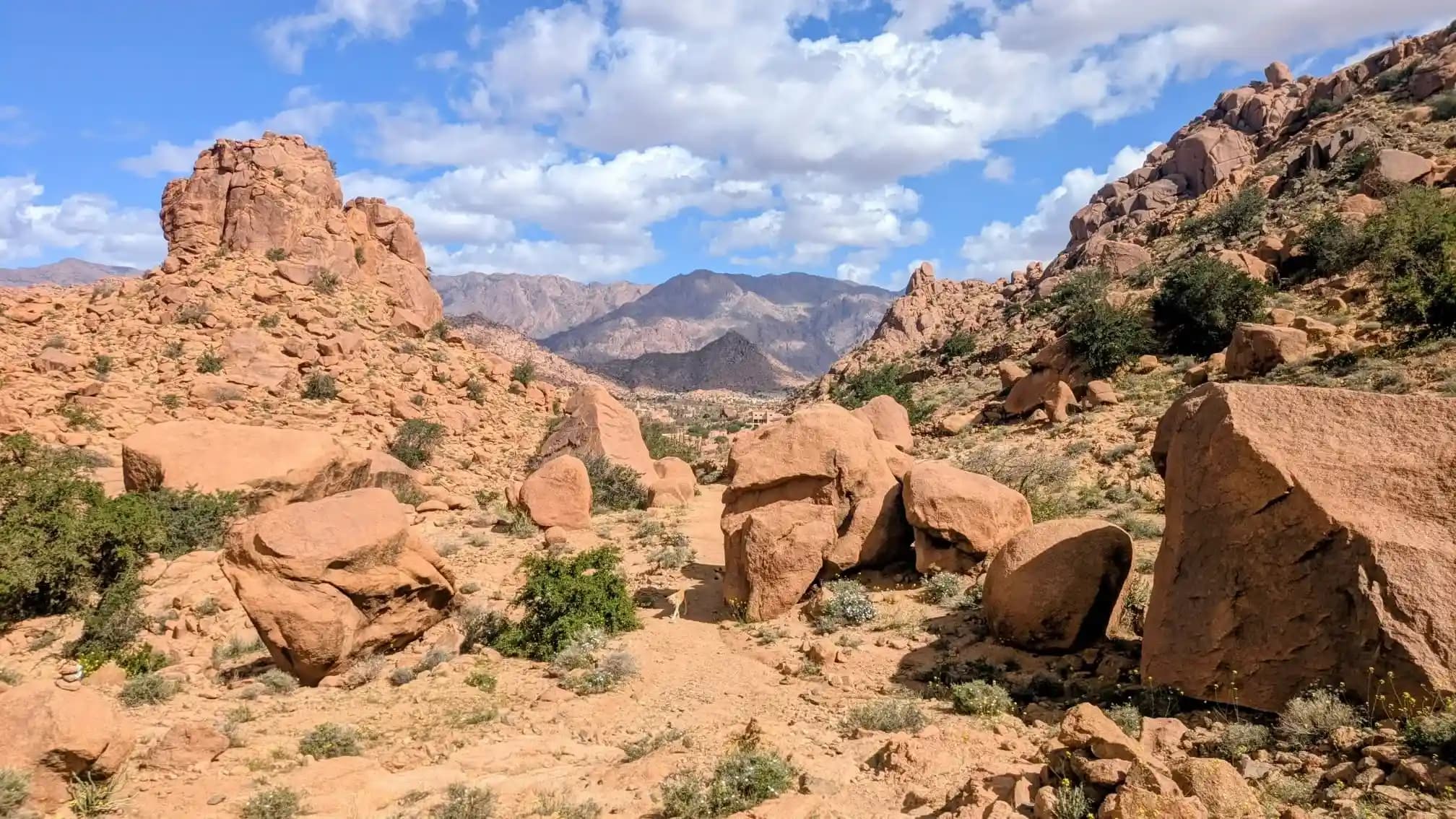
Tafraoute is an exceptional base for hiking. Here are a few popular routes:
- The Jbel el Kest Loop (3 to 4 days): a moderately difficult hike that circles the massive cliff overlooking the Ameln Valley. Overnight stays in Berber guesthouses each night.
- The crossing to the Aït Mansour Gorges (2 days): a descent from the Tafraoute plateau toward the southern palm groves.
- The Almond Tree Trail (4 to 5 hours): a loop accessible from Aguerd Oudad, ideal in February during the blooming season.
- The Ascent of Jbel el Kest (1 day): a 2,359-meter summit, accessible to experienced hikers with a local guide.
For any hike lasting more than half a day, it’s best to hire a local guide: the trails are poorly marked, and the weather can change quickly at higher elevations. Expect to pay 300 to 500 dirhams per day for a certified guide.
Extend Your Experience in the Anti-Atlas and the Souss
Tafraoute is best experienced as part of a larger journey. The region serves as a hub from which to explore other treasures of southern Morocco-often lesser-known but just as captivating.
Sixty kilometers to the southwest, Tiznit, the “City of Silver”, unfolds its medina, surrounded by ochre ramparts and home to a hundred jewelers’ workshops. Together, Tafraoute and Tiznit form a natural 2- to 3-day loop: one day of minerals and almond trees, one day of artisanal crafts and urban heritage.
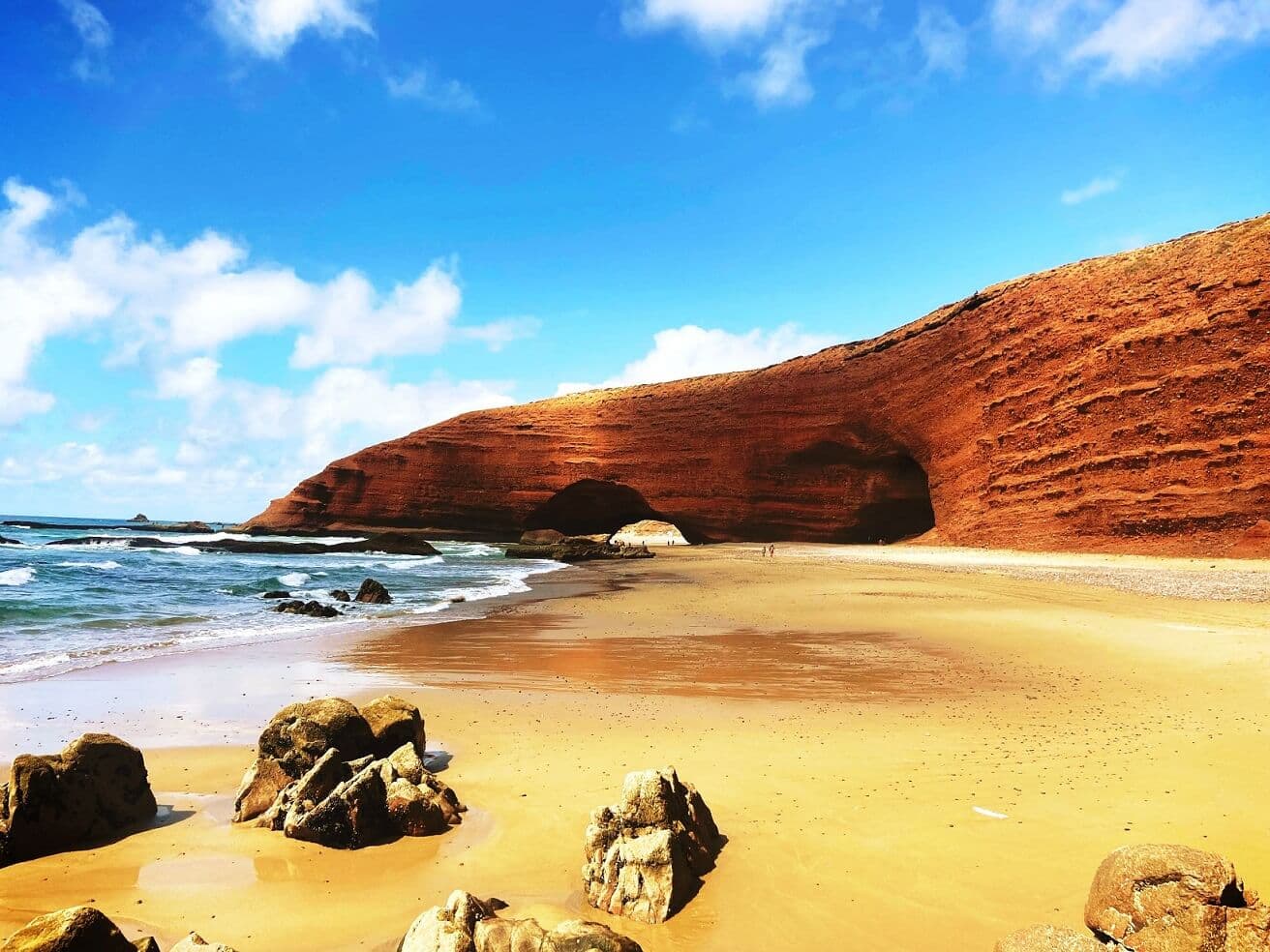
Further west, Mirleft and the southern coast, along with the red cliffs of Legzira, offer a completely different side of southern Morocco: the ocean, cliffs sculpted by the waves, and fishing villages. This is the perfect opportunity for a longer loop (4-5 days) that combines mountains, desert, and coastline.
To the north, the Valley of Paradise leads the way to Agadir with its natural pools and limestone gorges. The contrast with the pink granite of Tafraoute makes this a classic pairing for road trips through the south.
For those who want to understand the culture that animates the region, our article on Amazigh culture sheds light on the historical, linguistic, and social context of the Berbers of Souss and the Anti-Atlas. Tafraoute is one of its most vibrant centers.
To explore further, several of our immersive trips incorporate Tafraoute into a broader itinerary that combines craft workshops, walks through Berber villages, homestays, and encounters with the Ammeln communities. That’s what makes the difference between just passing through Tafraoute and truly experiencing it.
Practical Tips
Are there any admission fees?
No, not for the painted rocks, the Aït Mansour Gorges, or the Ameln Valley (free and open to the public). Yes, for the Traditional House of Oumesnat (20-30 dirhams) and certain private museums.
What gear should you bring?
Closed-toe hiking shoes (the granite is rough), a windbreaker, a hat, sunglasses, sunscreen, a water bottle, cash (few places accept cards), and a camera. In winter, bring a fleece and a hat for the evenings.
Do you need a guide?
For the town and the painted rocks, no. For the Ameln Valley in the backcountry or mountain hikes, yes. It makes all the difference in terms of cultural understanding.
Is there cell service and Wi-Fi?
Yes in the city and in most guesthouses; intermittent in the Ameln Valley; nonexistent in the Aït Mansour Gorges. Take the opportunity to unplug.
How many days should you plan for?
One day is the bare minimum (painted rocks, city center, brief visit to an Ameln village). Two days allow for a true immersion. Three to four days are ideal for exploring the Aït Mansour Gorges and going on a hike.
In summary
Tafraoute isn’t Marrakech. No “must-see” items to check off a list, no selfies every 50 meters, no carousel of tourist attractions. A town nestled in a basin of pink granite, Berber villages that haven’t forgotten how to live in the mountains, almond trees that bloom every year to remind us that winter always eventually gives way to spring.
If you come down from Agadir for 48 hours, you’ll leave with some stunning photos and the feeling that you’ve just touched upon something. If you stay for four days, you’ll leave with something else-something harder to put into words. Something like the desire to return-for longer-and on foot this time.