Drive past Tiznit, through Mirleft, and follow the signs for “Sidi Ifni.” Halfway there, you’ll find a roadside parking lot with no flashy signage. Park your car, walk down a few steps carved into the cliff, and suddenly, the landscape opens up.
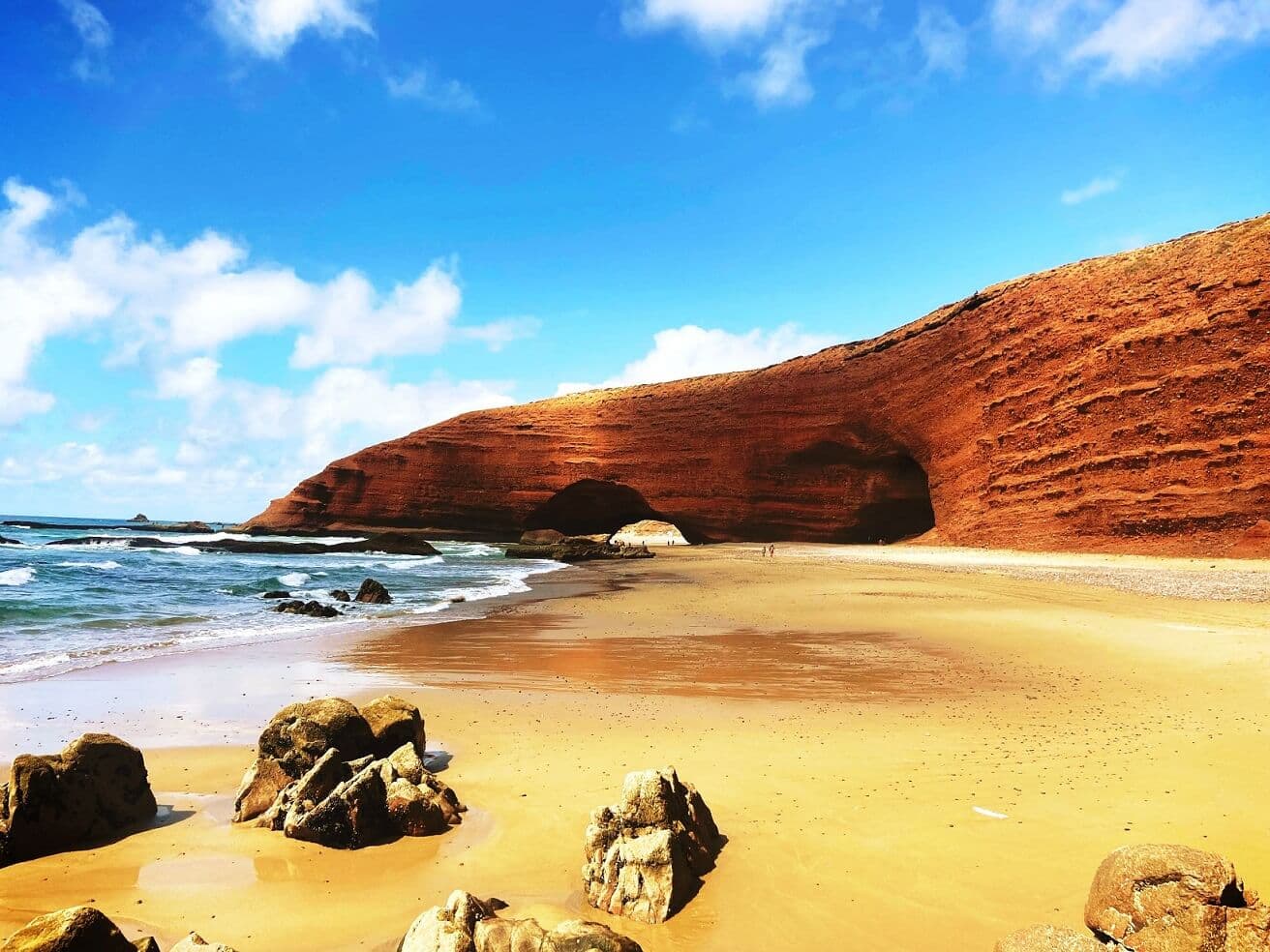
A strip of beige sand stretches as far as the eye can see, framed by sandstone cliffs that shift from orange to blood red depending on the time of day. And further on, standing like a stone cathedral in the ocean, is a natural arch 15 to 20 meters high. You’ve just arrived at Legzira, one of the most spectacular landscapes on the Moroccan coast.
Practical Information
Why Legzira Remains Unique in Morocco
There are only a handful of places on Earth where the sea has carved the rock into a natural monument. In Portugal, the Algarve coast comes to mind. In Australia, the Twelve Apostles. In Morocco, it’s Legzira. An 8-kilometer-long beach stretching between Mirleft to the north and Sidi Ifni to the south, where the red sandstone cliffs - eroded for millennia by the Atlantic - have left two monumental arches jutting steeply into the ocean.
The larger one, about 25 meters high, collapsed on September 23, 2016, due to the combined effects of heavy swells, wind, and cracks that had been widening for several months. Local residents had noticed the signs as early as spring.
When the arch collapsed, no one was injured, but Morocco lost one of its most beautiful natural landmarks overnight. Today, you can still see the enormous blocks that fell onto the sand, lying there like sculptures abandoned by their sculptor.
The second arch, smaller but still impressive, is still standing. It has become the star of the beach, and it’s the one pictured in all the guidebooks on Morocco. No one knows how long it will remain standing: erosion continues its patient work. It is this blend of the monumental and the fragile that makes Legzira so special.
And surrounding this centerpiece is an entire landscape: 8 kilometers of reddish sand, cliffs rising 50 or 60 meters high, hidden coves you discover as you walk, caves carved out by the waves, and a vast, empty horizon that reminds you that you’re at the westernmost tip of Morocco, where the continent ends.
What to see in Legzira?
Legzira’s main arch (the “survivor”)
This is the photo we all want to bring home. An arch of orange-red sandstone, 15 to 20 meters high, with both “feet” plunging into the ocean. At low tide, you can walk underneath it without getting your feet wet. At high tide, the waves rise and the arch becomes an island again. It’s located about 800 meters south of the main parking lot and is accessible via the beach.
The best time to photograph it: 1.5 hours before sunset. The low-angle sun literally sets the sandstone ablaze. If you come around noon, you’ll see the same arch, but dull and flat. The difference between a decent photo and one you’d hang on your wall comes down to just 30 minutes.
The Remains of the Great Arch
About 400 meters north of the parking lot, you’ll come across enormous blocks of sandstone that have collapsed onto the beach. These are the remains of the largest arch, which collapsed in 2016. These boulders are 5 to 8 meters high, and some weigh several dozen metric tons. It’s a silent sanctuary and a tangible reminder that this landscape isn’t eternal.
The Caves and Secret Passages
As you walk along the cliff at low tide, you’ll discover several shallow caves carved into the sandstone. Some occasionally serve as shelters for local fishermen. All are accessible on foot at low tide but inaccessible at high tide (when the water reaches the cliff). Don’t linger there if the tide is rising - the currents can be treacherous.
The northern beach toward Mirleft
If you head north, you’ll leave the arches behind and enter a much quieter, sometimes deserted area. The beach stretches for several kilometers all the way to Mirleft. This is the perfect option for those who want to walk for 1 to 2 hours through a spectacular rocky landscape without seeing a soul.
Sunset at Legzira on the Atlantic
Legzira faces due west. The sun sets there, plunging directly into the ocean, and the red cliffs, backlit by the setting sun, create one of Morocco’s most spectacular sunsets. Sit on a rock 30 minutes before the official sunset time and enjoy the view.
When to Visit Legzira for the Best Experience
The Best Seasons
From October through May, the weather is ideal: 18 to 25 degrees during the day, often clear skies, and soft light. April - May and October - November are the peak seasons, with moderate crowds and stunning colors.
Summer (June - August) is doable but uncomfortable: temperatures rise to 28-32 degrees, there are more people, and coastal fog can obscure the sunset.
Winter (December - February) is when the Atlantic swells are at their best. Ideal for surfers, less so for swimming (water temperature 16-17 degrees). If you’re visiting in winter, bring a windbreaker: the wind blows steadily and can get chilly quickly.
Check the tide
This is the key information to check before you go. At high tide, you won’t be able to reach the arch on foot, and certain parts of the beach will be inaccessible. At low tide, everything is accessible. Check the tide schedules on tide-forecast.com or via a mobile app (Tides Near Me) before your trip.
The absolute best plan: arrive 2 hours before low tide, enjoy the scenery as it opens up, then stroll back to your car before the tide comes back in.
What time to come
Two optimal times:
- 9am - 11am.: The light is soft, there are few visitors, and the arch is backlit by the morning sun.
- 4-7pm (depending on the season): the grand spectacle. The low-angled sun sets the cliffs ablaze, and the sunset over the arch is the quintessential souvenir photo.
Avoid 12pm - 3pm in the summer: harsh light, heat, and lots of tour groups.
How to get to Legzira?
From Agadir (150 km, about 2½ to 3 hours)
This is the most common route. Follow the N1 south, pass through Tiznit, and continue toward Mirleft. The “Legzira” sign appears on the right before Sidi Ifni. A roadside parking lot accommodates most visitors. Parking is paid (10-20 dirhams).
The road is fully paved and in good condition. A regular passenger car is more than sufficient.
From Sidi Ifni (10 km, 15 minutes)
If you’re staying in Sidi Ifni, it’s a 15-minute drive. This is the easiest way to enjoy both the best times of day (morning and sunset) without rushing.
From Mirleft (20 km, 30 minutes)
Mirleft is the option for those staying further north. A narrow but stunning coastal road runs along the cliffs.
By bus + grand taxi from Agadir
Take a CTM or Supratours bus to Mirleft or Sidi Ifni (3 hours, 60-80 dirhams), then a local grand taxi to the parking lot (30-50 dirhams). Total: 4 hours door-to-door, about 100-130 dirhams.
On an organized tour
Several tour operators in Agadir offer a day trip to Legzira, Mirleft, and Tiznit starting at 400 to 600 dirhams per person, including transportation and a guide. This is the easiest option for those who don’t want to drive. Several of our tours departing from Agadir include Legzira in 1- or 2-day itineraries that combine beaches, the medina, and Berber villages.
What to do in Legzira?
Take a walk on the beach
The main activity - paradoxically, one that’s often underestimated. A 1- to 2-hour walk along the sand, hugging the cliffs, passing under the arch, and exploring the caves: this is the best way to get a feel for the place. Wear closed-toe shoes if you want to scramble over the rocks; you can go barefoot on the sand.
Surfing
Legzira is one of the hidden gems of Morocco’s southern coast. The beach break breaks regularly, especially in winter and spring when there are long swells. Intermediate to advanced surfers recommended: the waves can be fast, and the rocks are close by. A wetsuit is required year-round.
For a more supervised surfing experience that’s more accessible to beginners, the surf spots of Agadir and Taghazout are better suited.
Photography
Even without professional gear, Legzira is an exceptional spot for photography. For amateurs with a telephoto lens, bring a tripod: the golden hour is worth a long exposure. A wide-angle lens is useful for fitting the entire cliff into the frame.
Wildlife Watching
The cliffs are home to several species of seabirds: Audouin’s gulls, crested cormorants, and terns. At low tide, starfish and barnacles appear in the pools on the rocky beach.
Swimming (with caution)
The water is cold (16-19 degrees depending on the season), the currents can be strong, and there is no lifeguard station. Swimming is still possible in the summer if you exercise caution and stay close to the shore. For a true swim in warm ocean waters, the ocean off Agadir or Taghazout will be more inviting.
Camel rides
On some days, one or two camel herders offer rides on the beach upon request. Expect to pay 100-150 dirhams for 30 minutes. A peaceful and picturesque experience at sunset, but no guarantee of availability: it depends on the season and the camel herders’ mood.
Where to Stay and Eat Around Legzira
Accommodations
There are no hotels directly on the beach. The best options are in Mirleft (20 km north) or Sidi Ifni (10 km south). A few more low-key guesthouses also exist along the coastal road.
In Mirleft, expect to pay 250 to 600 dirhams per night depending on the standard, often with a sea view. In Sidi Ifni, there’s a wider selection, ranging from hostels at 150 dirhams to boutique hotels at 800 dirhams.
Dining
On Legzira Beach, two or three small seaside restaurants serve simple grilled fish. It has a “beach hut” vibe, a short menu, and reasonable prices: 80 to 150 dirhams for a fish dish with fries and salad. Squid, sea bream, and sardines are available depending on the catch.
As for drinks, mint tea for 15 dirhams is served at any time of day. Black coffee is also available, but no alcohol.
For a more substantial meal, head back down to Sidi Ifni: several restaurants serve more elaborate Moroccan cuisine in this charming Spanish colonial town.
Practical Tips
Is there an entrance fee?
No, access to the beach is free and open to everyone. Only parking is subject to a fee: 10 to 20 dirhams, depending on the makeshift parking attendant.
What should you bring?
Shoes that can get dirty (closed-toe sandals or sneakers), a swimsuit, a towel, a windbreaker, a hat, sunglasses, sunscreen, cash (few places accept cards), water, and a camera (with a telephoto lens if possible).
Is the beach suitable for children?
Yes, to some extent. The beach and the arch will fascinate children ages 4-5 and up. Keep a close eye on them near the rocks and the sea (strong currents). Avoid sections that are closed off at high tide.
Is there cell service and Wi-Fi?
Intermittent 3G/4G service. No Wi-Fi on the beach. Let your loved ones know in advance.
Is there a risk that the remaining arch could collapse?
No one can say for sure. Erosion continues to take its toll, and local park rangers have noted a few cracks. As a basic safety precaution: don’t stay directly under the arch for long, and keep your distance during heavy swells.
How much time should you plan to spend there?
At least 2 to 3 hours to see the highlights (arch + walk + photos). Ideally, half a day - or even a full day - if you want to take a long walk to Mirleft and catch the sunset.
Extending Your Legzira Trip: Exploring the South Coast
Legzira is a highlight, but it really comes into its own as part of a larger coastal loop.
Twenty kilometers to the north, Mirleft - a coastal town in southern Morocco - is a cliffside village perched above the ocean, famous for its outdoor cafés, surf spots, and seven nearby beaches. It’s the ideal base for exploring the southern coast without having to change hotels.
10 km to the south, Sidi Ifni is a charming Spanish colonial town, with its white medina featuring blue shutters, its ancient fort, and its Art Deco cafés. A must-see if you’re in the region.
60 km to the northeast, Tiznit - the “City of Silver” - completes this grand loop: a medina surrounded by 7 km of ochre ramparts, 100 jewelry workshops, and a Thursday market. A different pace, a different landscape, another dimension of southern Morocco.
And further north still, 60 km north of Agadir, Timlaline and Tamri offer another spectacular landscape: ochre dunes that plunge into the Atlantic, just an hour from Agadir. The northern counterpart to Legzira, so to speak.
On the road from Agadir, the Souss-Massa National Park offers a 2- to 3-hour nature stop: bald ibises, flamingos, and gazelles. A lovely stop to break up the journey and discover the southern coastal ecosystem.
For those seeking a journey that goes beyond a simple souvenir photo, several of our immersive trips include Legzira as part of a 3- to 5-day itinerary that combines the ocean, cliffs, and Berber villages, with stops at local artisans’ workshops and with host families. That’s how you turn a spectacular beach into a living memory.
In short
Legzira isn’t a place you just pass through. It’s a beach where you linger, where you sit, where you walk, where you wait for the light to shift. The red sandstone, the standing arch, the remains of the one that fell, the ocean that has been sculpting all of this for millennia: you feel infinitely small, and that’s exactly what you’ve come for.
If you take a day trip down from Agadir, you’ll leave with some beautiful photos. If you stay for two days (using Mirleft or Sidi Ifni as a base), you’ll leave with something else: the experience of having seen a landscape at different times of day, at different tides, and in different lighting. And the certainty that you’ll have to come back, because the arch that remains might not be there forever.
Keep reading
- Things to do in Agadir
- Tafraoute (Morocco): pink granite and the Anti-Atlas Mountains, 3 hours from Agadir
- Agadir Amazigh Heritage Museum
- Agadir 3-Day Itinerary: What to Do in 3 Days or a Weekend
- Mirleft Morocco: Beaches, Cliffs and the Anti-Atlas near Sidi Ifni
- Taroudant (Morocco), the "Little Marrakech": Saadian ramparts