Jemaa el-Fna Square is the nerve centre of Marrakech: a large, free, open-air square listed by UNESCO, which in a few hours goes from lively market to the biggest open-air restaurant in Morocco. Storytellers, Gnawa musicians, snake charmers, orange juice sellers and rooftop terraces: you come back every evening of your stay.
But the square also has its share of tourist traps. Here is our 2026 guide to making the most of it, deciding whether to go by day or by night, and avoiding the most common scams.
Practical information
How to enjoy Jemaa el-Fna Square without being ripped off
Yes, Jemaa el-Fna Square is well worth the visit: it is the one experience that sums up Marrakech. To enjoy it without nasty surprises, remember three simple rules.
First, nothing is free: if someone hands you a monkey or a snake, or grabs your hand for a henna design, you will be asked for money. Agree a price beforehand, or refuse clearly.
Second, the best time is late afternoon and early evening, when the square comes alive without yet being packed. Third, keep your belongings in front of you in the evening: the crowd attracts pickpockets. With these habits, Jemaa el-Fna goes from supposed tourist trap to the best free show in town.
The square is something you live, not something you visit like a museum. There is no ticket, no opening time, no set route: you walk in freely, stroll around, sit down on a terrace, come back. The only real "cost" of Jemaa el-Fna is the attention you need to keep when people approach you.
One last tip before diving into the atmosphere: leave your valuables at the riad, carry small change rather than large notes, and learn two words of Arabic, "la, shukran" (no, thank you), said with a smile. It is often the most effective way to turn someone down without any tension. The people of Marrakech are welcoming, and the great majority of exchanges on the square are warm as long as the rules are clear.
The scams on Jemaa el-Fna Square and how to avoid them
The square is safe overall, but a few practices come up again and again and sometimes spoil the visit for travellers who have not been warned. None is dangerous if you know the rules of the game.
The principle is always the same: a service or an attention is pressed on you with no price given, then you are asked for far more than it is worth. The answer fits in one sentence: accept nothing without fixing the price, and do not hesitate to say no. Here are the most common cases.
Photos with monkeys and snake charmers
This is the best-known scam. As soon as you go near a snake charmer or a monkey handler, or if an animal is placed on your shoulder, you will be charged for a photo, often far more than you imagine. The sums asked commonly range from 100 to 300 dirhams, sometimes more, with no price displayed.
Our advice: if you are tempted, fix the price in advance and have the exact change ready; otherwise, take your photos from a distance without coming closer, or walk on. Be aware too that these practices raise a real animal welfare problem, as Barbary macaques are an endangered species.
Henna: agree the price and refuse black henna
Henna artists walk around the square and may grab your hand to start a design before you have even agreed. A small, reasonable design can be negotiated for a few dozen dirhams, but without an agreement beforehand the bill can climb to several hundred dirhams.
Two rules: agree the design AND the price before anyone touches you, and always refuse "black henna", which often contains paraphenylenediamine (PPD) and causes allergic reactions that can be severe. Natural henna is orange-brown, never black.
Orange juice, fake guides and pickpockets
The other traps are minor and easy to avoid:
- Orange juice: a glass costs a few dirhams (often 5 to 15 DH depending on the stall); glance at the price displayed, as some stalls serve juice that has been watered down or topped up with syrup.
- Fake guides: anyone who spontaneously offers to guide you without an official badge is looking to be paid or to take you to a shop that pays commission. Licensed guides wear a badge; politely decline the others.
- Pickpockets: the evening crowd makes pickpocketing easier. Keep your bag closed in front of you and your phone in a front pocket.
- Stall touts: you will be called from every side at dinner time. Choose a stall where Moroccans are eating rather than the one shouting loudest.
Day or evening: what time to go to Jemaa el-Fna?
The square changes completely depending on the time of day. If you can, come twice, by day and then at night; otherwise, choose the end of the day.
Jemaa el-Fna Square by day
In the morning and afternoon, the square is calmer and easier to take in: orange juice sellers, the first snake charmers, horse-drawn carriages and water sellers (guerrab) in colourful costume, recognisable by their tasselled hats and copper cups. It is the right time for a first look around without the crush, and for photographing the nearby Koutoubia in good light.
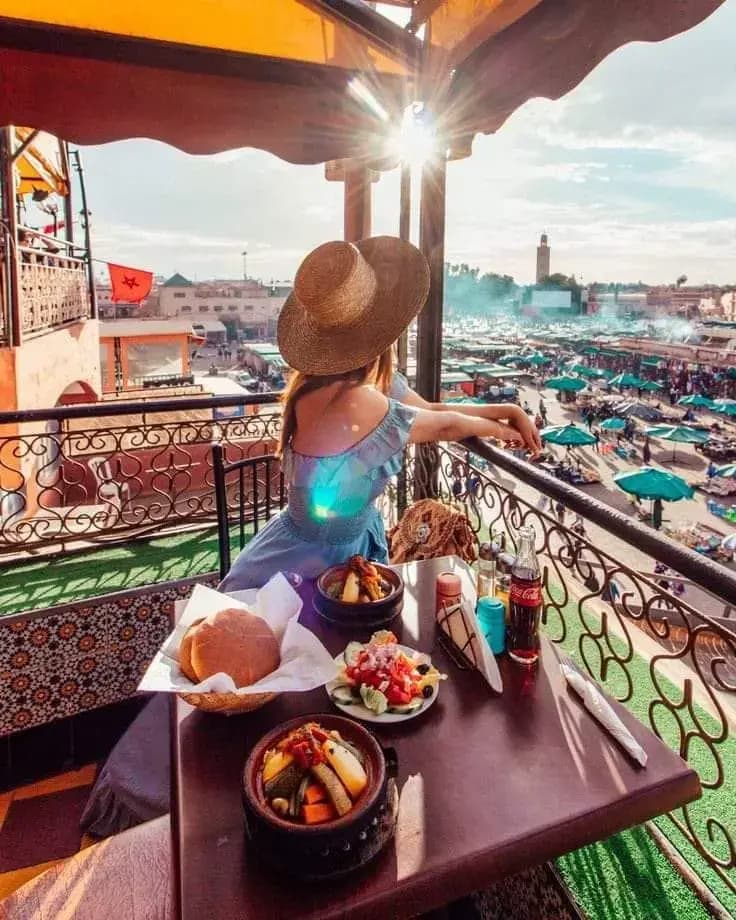
You are approached less often than at sunset, which makes it a more restful time for families with children. The heat can be intense in summer: take the opportunity to settle on a rooftop terrace, with a bird's-eye view of the square and the medina, over a mint tea.
Jemaa el-Fna Square in the evening
It is at dusk that the square truly comes into its own. Around 4 to 5 pm, the food stalls set up and the first smoke rises; between 7 and 11 pm, the activity peaks: grills, halqa (circles of spectators) around the storytellers, Gnawa troupes, acrobats, animal handlers and musicians share the space in a hubbub like no other.
It is the most spectacular moment, but also the most crowded, and the one when you most need to watch your bag. To take it in without being jostled, a good tactic is to go up to a terrace first and see the square from above at golden hour, then come back down and mingle with the crowd once night has fallen. If you were to come only once, come in the evening.
What to see and do on Jemaa el-Fna Square
Jemaa el-Fna Square is not a monument but a living show that renews itself hour by hour. On the programme:
- The storytellers (hlaykia), heirs to a centuries-old oral tradition, who hold their circle spellbound in Moroccan Arabic
- The troupes of Gnawa musicians, with their metal castanets and hypnotic chants
- The snake charmers and their flutes, early in the day
- The henna artists and the sellers of freshly squeezed orange juice
- The evening food stalls, lined up by the dozen under the lamps
- The raised café terraces, perfect for watching the square from above at sunset
Bring small change if you plan to listen to a storyteller or photograph a musician: a coin dropped in the hat is the rule, and far more honest than a "stolen" photo.
What makes the square unique is not its buildings but its voices. The hlaykia keep alive an oral tradition handed down from generation to generation, mixing tales, legends, history and improvisation, sometimes late into the night. It is precisely this living culture, fragile and rare on a world scale, that UNESCO set out to protect.
Taking the time to stop in a circle, even without understanding Moroccan Arabic, is part of the experience: you can read a great deal in the storyteller's gestures and the audience's reactions.
Eating at the evening stalls: our tips
At nightfall, dozens of numbered stalls set out tables and benches: it is the biggest open-air restaurant in the country. You can try kebabs, merguez sausages, Marrakech tangia, harira soup, cooked salads, fried fish and, for the more adventurous, snails in broth (babbouche). A few habits will save you from disappointment:
- Choose a stall full of Moroccan customers: a fast turnover means fresh food.
- Ask the price of each dish BEFORE ordering: an inflated bill is a classic cause of disputes.
- Allow 50 to 100 dirhams in general for a full meal including a drink, but it depends on what you order.
- Be wary of bread and nibbles that are "offered": they are often charged for if you eat them.
Beyond the meal, dinner at the stalls is part of the show: you sit elbow to elbow with other travellers and Marrakech families, under the light bulbs and the smoke, while the vendors compete in humour to attract customers. It is noisy, a little chaotic, and exactly what you come for.
If you prefer calm and more refined cooking, the terrace restaurants around the square offer the same view with the comfort of a proper table, for a slightly higher budget.
Where the name "Jemaa el-Fna" comes from, and its UNESCO listing
The square has existed since the founding of Marrakech by the Almoravids in the 11th century, and became the meeting point of the caravans, the great market and the gathering place of the city. For centuries everything happened here: trading, listening to storytellers, attending proclamations and, it is said, public executions.
The name "Jemaa el-Fna" is often translated as "the assembly of the dead" or "the mosque of annihilation". The most widespread explanation, to be taken as a hypothesis, refers to a great mosque that was planned but never completed, or precisely to those executions of the past.
In 2001, UNESCO proclaimed the square a "Masterpiece of the Oral and Intangible Heritage of Humanity", a distinction confirmed by its inscription on the Representative List in 2008. Do not confuse the two: it is the living tradition of the square, the storytellers and musicians, that is protected, while the medina of Marrakech has been a World Heritage Site since 1985.
Since 2025, the square has been undergoing a major renovation programme (paving, layout and accessibility). It remains open and lively, but expect to come across work areas here and there while the improvements are carried out.
How to get to Jemaa el-Fna Square and where to park
The square lies at the centre of the medina, and the whole historic centre converges on it: from most riads, you can walk there in a few minutes. In a petit taxi (beige), insist on the meter for a journey costing a few dirhams; Marrakech has no metro. There is an underground car park beneath the square, and another near the Koutoubia, a few minutes' walk away.
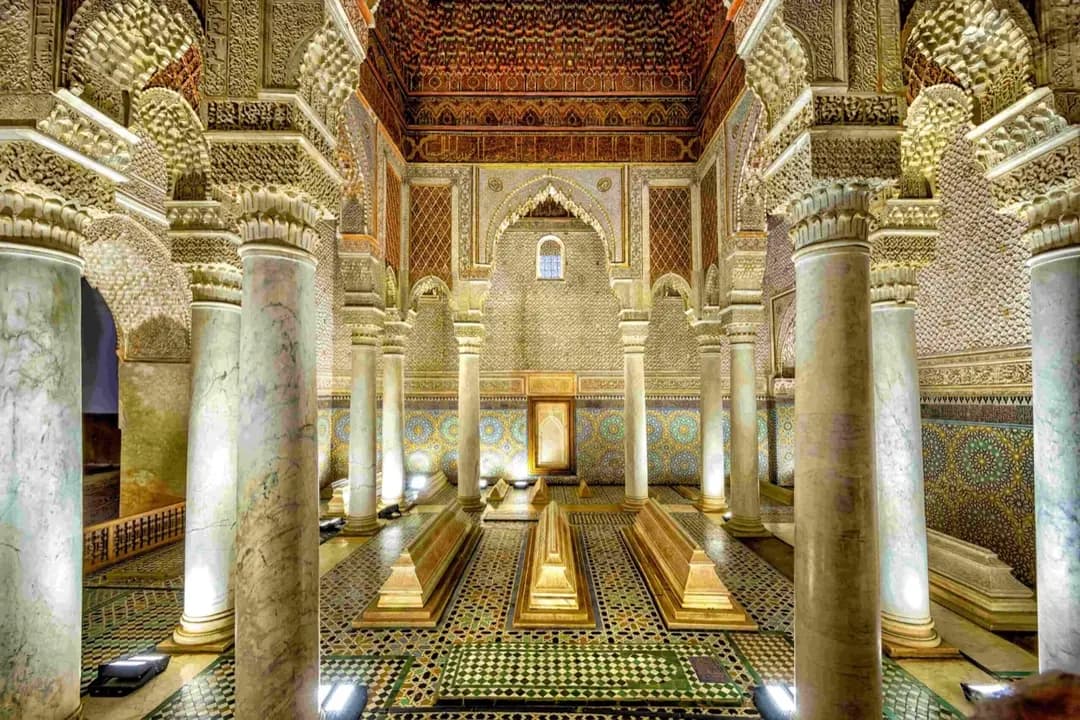
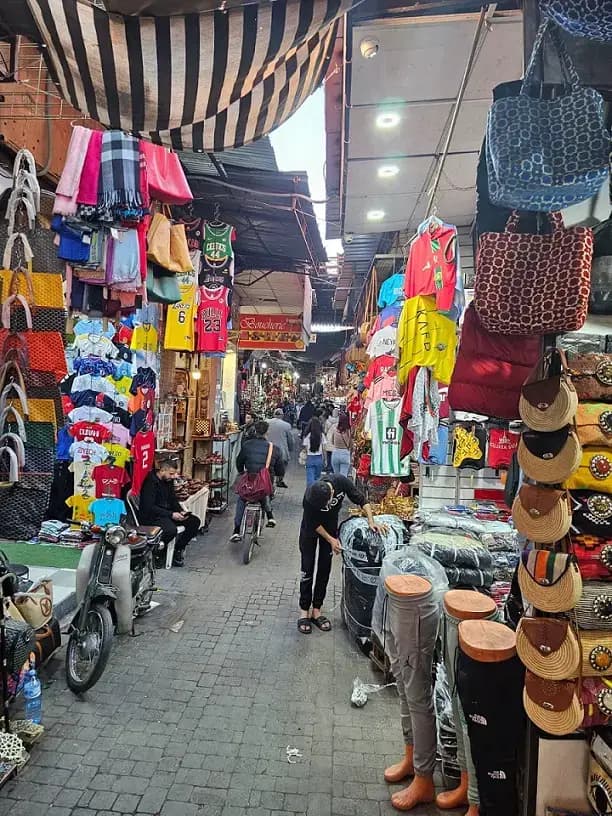
From Jemaa el-Fna, you can easily reach the souks to the north, and to the south the Bahia Palace and the Saadian Tombs: it is the ideal starting point for exploring the medina.
What to see around Jemaa el-Fna Square
The square is the best base for exploring Marrakech on foot. Continue your visit with the Ben Youssef Madrasa to the north, a former Koranic school with remarkable decoration, and with the silhouette of the Koutoubia towering over the city.
To plan your whole stay, see our guide to things to do in Marrakech and the Marrakech city page. And if the crafts you glimpse in the souks make you want to try your hand, book a zellige workshop in Marrakech or a pottery workshop with an artisan.
Keep reading
- Things to do in Marrakech
- Medersa Ben Youssef in Marrakech: visit, prices and tips 2026
- Koutoubia Mosque in Marrakech: can you visit it? Guide 2026
- Visit the Bahia Palace in Marrakech: prices, opening hours and tips 2026
- Lalla Takerkoust Lake from Marrakech: activities and tips 2026
- Oukaïmeden from Marrakech: Skiing, Snow, and Hiking 2026