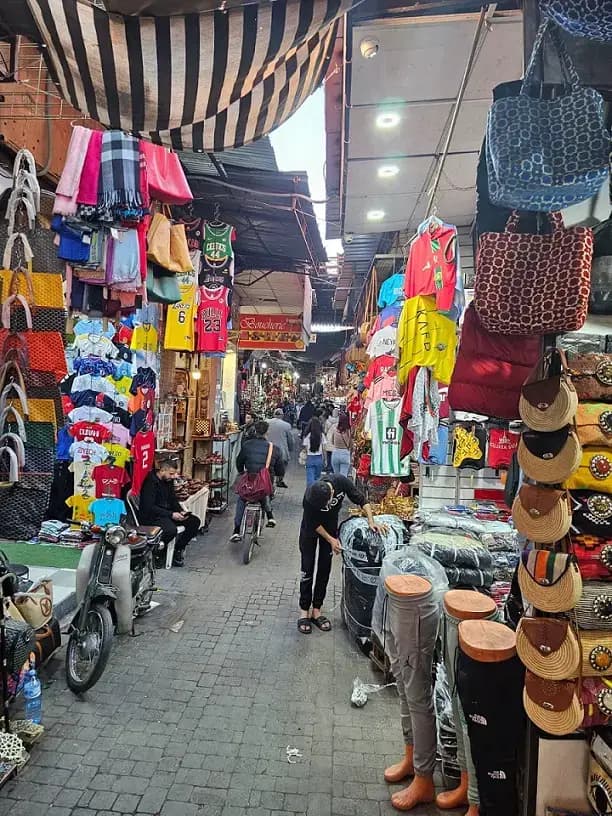
Visiting the Marrakech souk means losing yourself in a maze of covered alleys north of Jemaa el-Fna Square, where each quarter is devoted to one trade: spices, dyers, babouches, lanterns, leather goods. Wandering around is entirely free, but the first price you are quoted never is. Here is our 2026 guide to haggling without being ripped off, finding the real souks trade by trade, and enjoying the medina without falling into the most common traps.
Practical information
Marrakech souk: tourist trap or artisans' market?
The souks of Marrakech are not a tourist trap: they are real working artisans' markets, and strolling through them costs nothing. The "trap" is not the souks themselves but three habits you need to know.
First, haggling is the rule: the first price quoted is deliberately inflated, so make a counter-offer of around 40 to 50% of that price, then come up gently; the final price often falls between half and two thirds of the starting price.
Second, pretending to leave almost always brings the price down: it is the most effective signal. Third, refuse the "fake guides" who offer to accompany you: they are paid on commission by the shops and push up what you spend. With these three habits, you can enjoy the souks without being ripped off.
One reality has to be accepted: you come to the souk for the experience as much as for the shopping. The hubbub, the smells of spices and leather, the sparks from the coppersmiths, the light falling through the reed lattices: that is the show. If you keep your calm and your sense of humour, haggling becomes a game rather than a chore.
A word on attitude, because it changes everything. The seller is not your opponent: haggling is a social ritual, often accompanied by mint tea and jokes. State a budget from the outset, keep smiling, and do not be afraid of silence or long pauses, which are part of the game.
If a price suits you, pay it without regret, even if you could have shaved off a few more dirhams: the difference is often trivial for you and matters more to the artisan. Conversely, do not haggle over something you have no intention of buying; it is frowned upon.
Haggling in the Marrakech souk: what price should you aim for?
The method comes down to a few simple principles:
- Ask the price, then make your first counter-offer at around 40 to 50% of the amount quoted.
- Come up in small steps; aim for a final price between 50 and 70% of the starting price, depending on the product and how busy it is.
- Never accept the first price and do not show your interest too quickly: stroll, compare, come back.
- If the seller does not follow, say thank you and leave: nine times out of ten he will call you back with a better price.
- Haggle in dirhams, not euros, and with small notes (the seller "never has change").
These percentages are rough figures shared by most guides, not an absolute rule: the end of the day, a quiet souk or buying several items all work in your favour.
Scams to avoid: fake guides, touts and tanneries
A few classics come up again and again; none is dangerous if you know how to respond:
- Fake guides: someone offers to show you the way or "a workshop that is about to close". They are paid commission by the shops. Decline politely; licensed guides have a badge.
- The "exit is this way" trick: you are pointed in the wrong direction to lead you astray towards a shop. Trust your offline map rather than a stranger in a hurry.
- The "free" tanneries: you are offered a visit to the tanneries "without paying", before being asked for a large tip and pushed to buy. The tanneries are a production area, not a trade souk; only go knowing that.
- Fake argan and fake saffron: on the spice stalls, much of the "saffron" is actually safflower, and argan oil is sometimes cut with other oils. Buy from a cooperative, or ask to taste and smell.
Where the souks are and how to get there
The souks occupy the whole northern part of the medina, between Jemaa el-Fna Square to the south and the Ben Youssef Madrasa to the north. Everything converges on them: from most riads, you can walk there in a few minutes.
Access is free and the whole area can only be explored on foot, as the alleys are too narrow and too crowded for cars; only two-wheelers and carts squeeze through, so stay alert. The medina of Marrakech, home to the souks, has been a UNESCO World Heritage Site since 1985: this labyrinth of covered alleys has no equal in Morocco.
Entering from Jemaa el-Fna Square
The simplest starting point is Jemaa el-Fna Square: on the north side of the square, two arches mark the entrance to Souk Semmarine, the main artery, wide and covered with a reed roof that filters the light. From there you head north and the specialist souks open up on either side, like the bones of a fish.
Souk Semmarine continues as Souk El Kebir, then branches out: to the right towards Rahba Kedima and the spice souk, to the left towards the babouches and the leather. The Koutoubia to the south-west and the Ben Youssef Madrasa to the north serve as landmarks to stop you going round in circles, as does the Kessaria, the old covered market at the heart of the layout.
How not to get lost in the Marrakech souk
Getting lost is part of the pleasure, but a few landmarks will keep the anxiety away:
- Remember that Jemaa el-Fna is always to the south: to get out, head due south.
- Souk Semmarine is the central axis; as long as you can find it again, you know where you are.
- Download an offline map, as the signal is poor under the lattices.
- Do not hesitate to step into a shop to ask the way, without accepting an escort.
The souks of Marrakech, trade by trade
What makes the place so distinctive is its organisation by trade, inherited from the guild system. The main souks to look out for:
- Souk Semmarine: the main artery from Jemaa el-Fna, with textiles, babouches and souvenirs.
- Rahba Kedima: the square of spices and herbalists, formerly the grain market.
- Dyers' souk (Sebbaghine): skeins of dyed wool drying, hung above the alleys.
- Souk Haddadine: blacksmiths and ironworkers, in a din of hammers on iron and copper.
- Souk Smata: babouches, lined up by the hundred in every colour.
- Souk Cherratine: leather and leather goods, bags, pouffes and belts.
- Place des Ferblantiers: lanterns and lamps in chased metal, a stone's throw from the Bahia Palace.
Two quarters are worth a detour, even if you are not buying. Rahba Kedima, the spice square, lines up pyramids of cumin, paprika and dried mint, phials of perfume and herbalists' stalls offering traditional remedies, black soap and dried flowers.
The dyers' souk (Sebbaghine) is the most photogenic: skeins of wool freshly dyed blue, saffron or fuchsia dry hanging across the alley, above the vats of colour. A little further on, the din of Souk Haddadine announces the blacksmiths, while the smell of leather leads to Souk Cherratine.
Take the time to watch the artisans at work: it is free, often more impressive than the shops themselves, and also the best way to understand what an object is really worth before you negotiate. Many workshops occupy former fondouks, the caravanserais with a central courtyard where merchants once lodged; a few can be visited and are worth a look for their architecture.
What to bring back from the Marrakech souk
The Marrakech souk is one of the best places in Morocco to bring back crafts, provided you haggle. The safe bets:
- Leather babouches from Souk Smata, foldable and light in the suitcase.
- Lanterns and candle holders in pierced metal from the Place des Ferblantiers.
- Leather goods (bags, unstuffed pouffes, belts) from Souk Cherratine.
- Hand-knotted Berber rugs, whose price varies enormously with size, wool and origin.
- Spices, teas and herbs from Rahba Kedima, keeping an eye out for fake saffron.
- Argan oil, best bought from a cooperative for purity.
- Pottery and ceramics from Safi or Tamegroute, more fragile to transport.
A few pointers for judging quality before you haggle: a hand-knotted Berber rug can be recognised by the slight irregularity of its knots seen from the back, not by a perfectly even back (often a sign of machine manufacture). A real leather babouche has a distinct smell and neat stitching, whereas imitation leather has no smell.
Cosmetic argan oil is odourless and cold-pressed, while the culinary kind has a pronounced toasted aroma; be wary of "argan" that is too cheap, as it is often cut. As for saffron, the real thing colours water slowly and keeps its thread shape: a red that runs instantly gives away safflower.
For heavy or fragile items (large rugs, pottery), many shops offer shipping by carrier: ask the cost and the delivery time before you decide, and keep a photo of the item you bought.
Opening hours, closing day and payment
The souks have no official opening hours: most shops open at around 9 am and close between 8 and 9 pm, sometimes with a lull in the early afternoon in summer. The morning, between 9 and 11 am, is the best time to see the artisans at work and enjoy a souk that is still calm; at the end of the day, the atmosphere is denser.
Are the souks open on Fridays?
Yes, the souks stay open on Fridays, but many shops pull down their shutters for the main prayer, generally between midday and about 3 pm. Avoid that slot if you want to see everything open, and resume your visit in mid-afternoon.
As for payment, bring cash: cash in dirhams is king in the shops, where bank cards are rarely accepted and unreliable. Withdraw money before entering the medina, as cash machines there are few and often besieged. Keep a little small change too for the porters or the public toilets, which charge a fee.
Visiting the souks with or without a guide
You do not need a paid guide to stroll through the souks: wandering is free, and that is the best way to appreciate them.
An official guide, recognisable by a badge, can make sense if you want the history of the fondouks and guilds in a structured half-day, or if the labyrinth makes you anxious; in that case, allow for a fee agreed in advance for a walking tour. But steer clear of the improvised guides you meet in the street, who will mostly lead you to the shops that pay them commission.
For a first visit, a good tactic is to explore freely in the morning, when it is calm, then come back in the afternoon to shop, once you have spotted the shops and have a rough idea of prices.
If the crafts you glimpse in the souks make you want to go further than simply buying, the best thing is to get your hands on the materials.
To plan your stay, see our guide to things to do in Marrakech and the Marrakech city page. And to understand the gestures behind the objects, book a zellige workshop in Marrakech or a pottery workshop with an artisan. The souk also extends southwards, towards the Bahia Palace and the Saadian Tombs.
Keep reading
- Things to do in Marrakech
- Saadian tombs in Marrakech: visit, queue and tips 2026
- Medersa Ben Youssef in Marrakech: visit, prices and tips 2026
- Koutoubia Mosque in Marrakech: can you visit it? Guide 2026
- Visit the Bahia Palace in Marrakech: prices, opening hours and tips 2026
- Lalla Takerkoust Lake from Marrakech: activities and tips 2026