VisitBahia Palaceis one of Marrakech's most beautiful palaces, built at the end of the 19th century in the medina, on Riad Zitoun el Jdid street. Here, you can wander through eight hectares of courtyards, riads and salons with painted cedar ceilings, a ten-minute walk from Jemaa el-Fna square. But between the 100 dirham ticket, the crowds and the empty rooms, many visitors wonder whether the visit is worth the detour. Here's our complete 2026 guide: prices, timetables, duration, history and tips for enjoying the monument at the right time.
Infos pratiques
Is the Bahia Palace worth it?
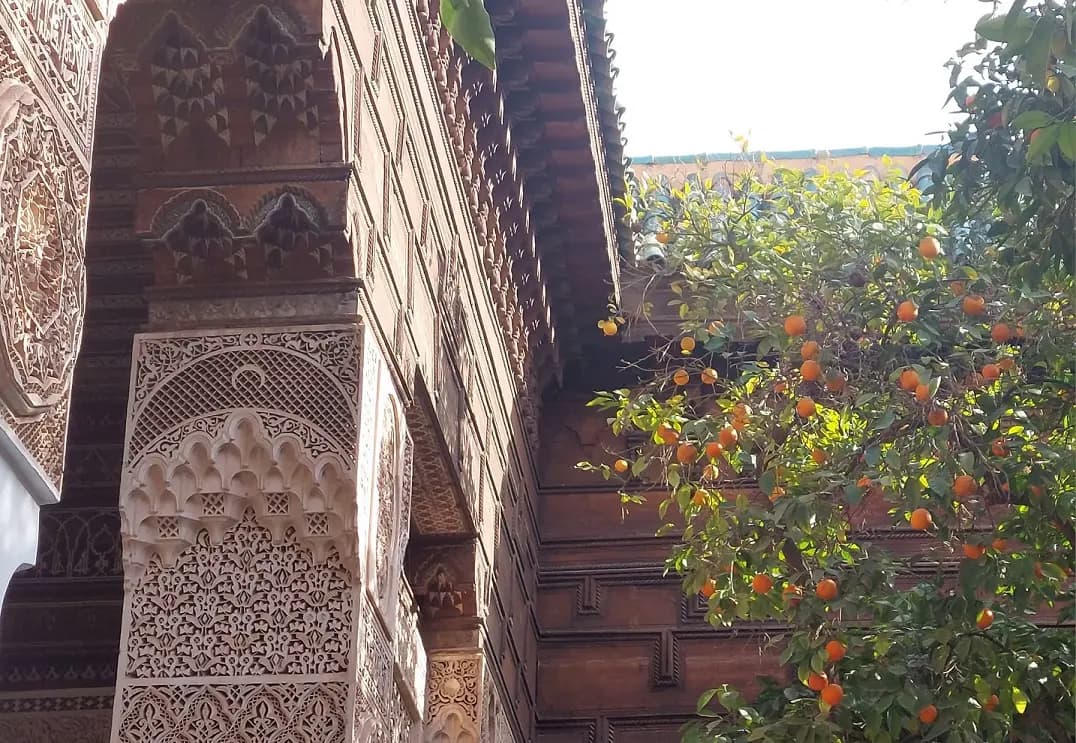
Yes, the Bahia Palace is well worth a visit, as long as you choose your schedule carefully. It's one of Marrakech's finest examples of Arab-Andalusian architecture: zelliges, hand-painted cedar ceilings and gardens planted with orange trees, spread over eight hectares. Two things surprise visitors, however. Firstly, the rooms are empty of furniture: you're visiting a decorated envelope, not a furnished museum. Secondly, the crowds become a nuisance after 10:30 a.m., when the groups arrive. Our advice: come as soon as the museum opens at 9 a.m. to enjoy the deserted courtyards and the morning light, allow 45 minutes to 1h15 for the visit, and take a guide if you want to understand the history of Ba Ahmed rather than wander between the walls.
For whom the visit is made: lovers of architecture, mosaics and photography, and all those who want to understand how the Moroccan court lived at the end of the 19th century. For whom it's not: if you're expecting a palace furnished in the style of a European château, or a museum of objects, you'll find the rooms a little bare. The pleasure here lies in the decor and lighting, not the furniture.
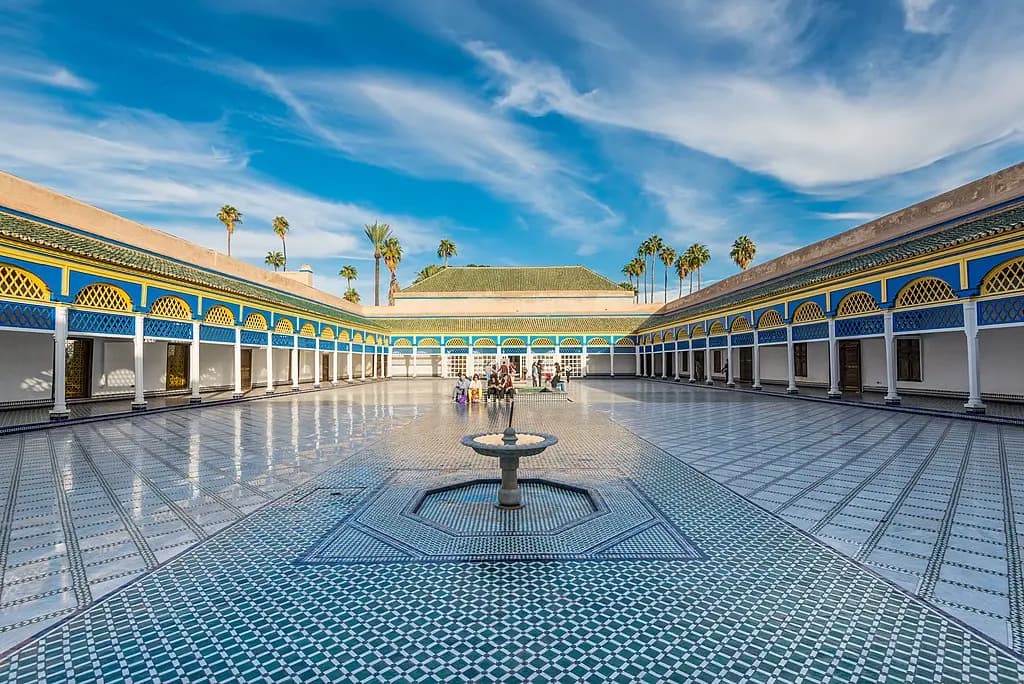
In terms of photography, this is one of Marrakech's most beautiful settings: marble patios, cedar doors, stained glass windows and polychrome ceilings lend themselves equally well to close-ups and enfilade views. The only constraint is light. From late morning onwards, the sun beats down hard on the open-air courtyards, crushing contrasts, while the crowds make unmanned compositions almost impossible. Here again, everything is decided before 10:30 a.m.
Admission to the Bahia Palace in 2026
The entrance fee for the Palais de la Bahia is 100 dirhams (around 10 euros) for a foreign adult in 2026, according to the Moroccan Ministry of Culture ticket office. This is the price you pay at the ticket office, at the entrance on Rue Riad Zitoun el Jdid.
How much does a ticket cost for a foreigner, child or resident?
Here is the tariff schedule for 2025-2026:
- Foreign adult: DH100 (approx. €10)
- Foreign children aged 7 to 13: DH30
- Children under 7: generally free admission
- Resident in Morocco, upon presentation of CIN or residence permit: 30 DH
- Resident children aged 7 to 13: DH10
Beware of a frequent confusion: several online guides still show 70 dirhams, a former price. According to the official ticket office, the adult foreigner price for 2026 is 100 dirhams. These prices are subject to change, as the Ministry regularly adjusts them: check the amount displayed at the ticket office.
Do I need to book tickets in advance?
No, you don't need to book the palace in advance. Tickets are bought directly from the cashier, and there are no official queue-jumpers: the "queue-jumpers" sold online by aggregators are actually guided tours, not priority queues. In high season (April-May, October, school vacations), a queue can form at the ticket office mid-morning; arriving when the ticket office opens solves the problem. You can also buy your ticket online via the Ministry of Culture's website, but the time saving is marginal.
Opening hours and best time to visit
The palace is open daily from 9am to 5pm, with no weekly closing days. The last entrance is about half an hour before closing time, at around 4.30pm: so don't expect to enter at 4.45pm. For light and calm, the ideal time is the first hour, just after opening, when the courtyards are still deserted and the low-angled sun brings out the relief of the stuccowork.
Times during Ramadan and public holidays
During Ramadan, opening hours are reduced: the palace closes earlier, usually around 3 or 4 pm depending on the year. It's best to aim for the early afternoon. As the building belongs to the State, it may also close occasionally and without notice for official events or receptions; such closures are rare but possible. In case of doubt, a call to your riad or a glance at recent online reviews will confirm that it is open that day.
How long does the tour take?
Allow 45 minutes to 1h15 for a self-guided tour, and up to 1h30 with a guide who takes the time to tell the story. The tour is shorter than you might imagine: the monument is large (eight hectares, around 150 rooms), but you only visit part of it, and the absence of furniture speeds up the pace. Visitors in a hurry can get around in half an hour; those who linger over each ceiling and patio will happily spend an hour and a half. Plan ahead if you're photographing: the play of light in the courtyards changes quickly in the early morning, and you often have to wait to capture a string of doors with no one in the frame.
Do I need a guide to visit the Bahia Palace?
The palace can be visited without a guide: the route is signposted and you can move freely from one courtyard to another. But without explanations, the rooms end up looking the same, as there is almost no commentary on site. A guide gives meaning to the visit: he tells the story of Ba Ahmed's ascent, makes you look up at the painted cedar ceilings, deciphers the symbolism of the zelliges and leads you to the apartments of the favorite, often the most decorated.
Count 150 to 250 dirhams for a guide at the entrance, or choose a guided tour of the medina that includes the palace and other monuments. Failing that, an audioguide or a good mobile app will suffice for the essentials. If you're really interested in the history of the dynasties and crafts, a guide is still the best investment of the day.
What to see inside: history and architecture
The palace tells the story of an era as much as it shows the setting. Understanding who built it and why changes the way we look at it.
Ba Ahmed and the history of the Bahia Palace
Construction of the Bahia Palace began in the 1860s and 1870s on the initiative of Si Moussa, the Sultan's Grand Vizier. The palace was then considerably enlarged between 1894 and 1900 by his son, Ba Ahmed (Si Ahmed ben Moussa), the strongman of the young sultan Moulay Abdelaziz's reign. Ba Ahmed gathered his wives, concubines and children here; the name "Bahia", "la belle" or "la brillante", is said to have come from one of his favorites. When Ba Ahmed died in 1900, the palace was looted within hours by his own servants. Later, during the French protectorate, it was used as the residence of the Resident General: Lyautey set up his offices there and received his guests, which helped to preserve it. The whole complex was built over a period of almost fourteen years, by hundreds of craftsmen from Fez and Marrakech, without any overall plan: land was purchased and gradually extended, which explains the somewhat labyrinthine layout. Today, the palace belongs to the Moroccan state and was reopened in autumn 2023, following the earthquake of September 2023.
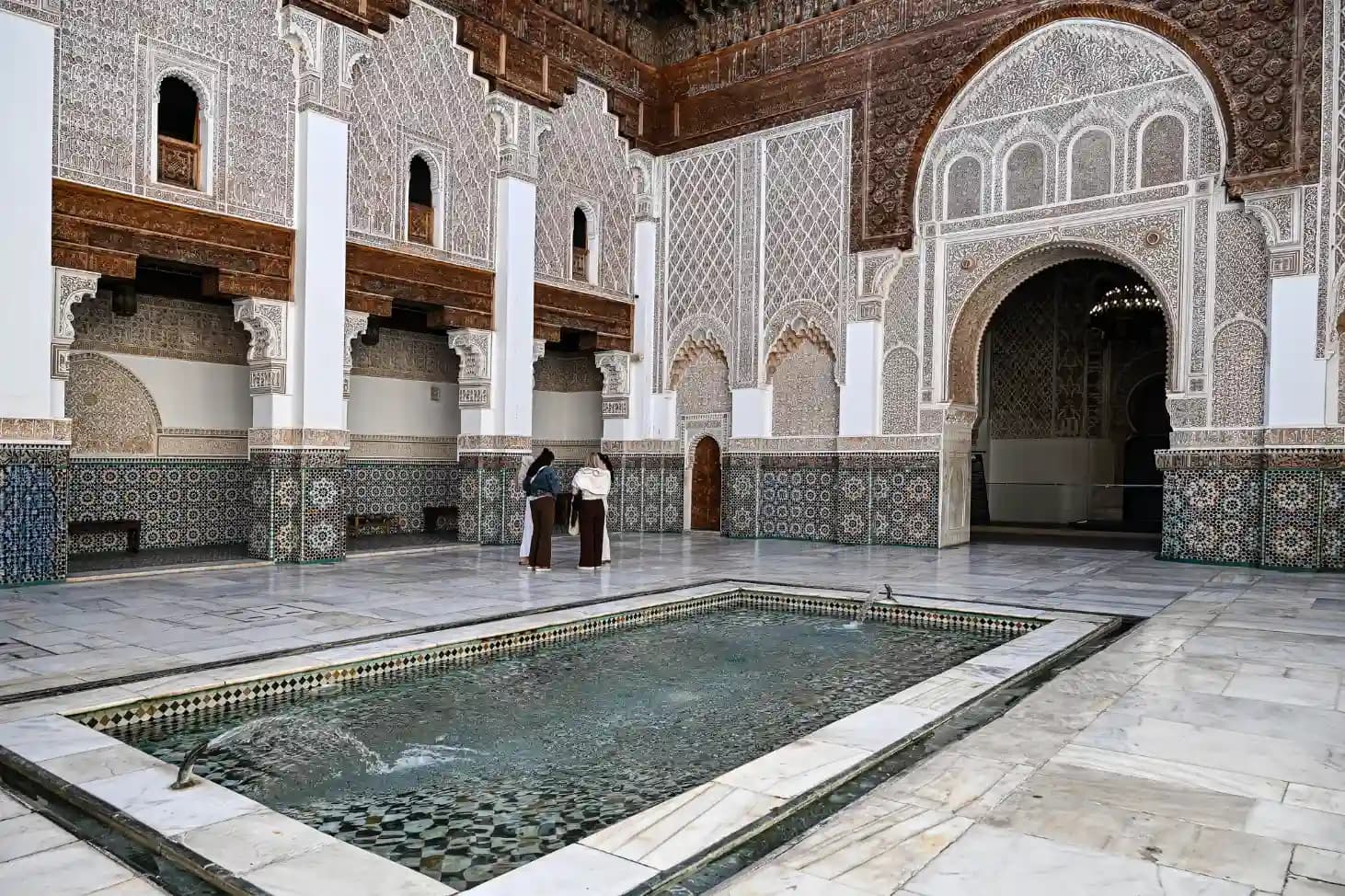
The courtyards, riads and gardens of the Bahia Palace
The palace is organized around courtyards and gardens linked by ornate passageways. Not-to-be-missed areas include:
- The main courtyard, a vast marble esplanade lined with columned galleries
- The small riad, the first interior garden planted with orange and banana trees
- The large riad, set around a central pool and Andalusian flowerbeds
- The favorite's apartments, with some of the most spectacular painted ceilings in the palace
- The lounges and boardroom, enclosed by carved cedar doors and moucharabiehs
Everywhere, the decor blends zellige (a ceramic mosaic with geometric motifs), gebs (finely chiselled stucco) and hand-painted cedar wood, in a typically Moroccan polychrome. The marble comes from Italy and Meknes, the cedar from the forests of the Middle Atlas, and each ceiling requires months of work. Always look up: most of the craftsmen's work is on the ceilings, where most visitors don't look.
The so-called "favorite's apartments", organized around an intimate courtyard, are among the most accomplished rooms: here, painted ceilings, colored stained glass and stuccowork reach their peak. The gardens, meanwhile, follow the Andalusian model: cross-shaped paths, ponds, orange trees, jasmine and cypresses, designed to freshen the air and soothe the eye. Take the time to sit for a moment in the shade of a gallery: it's in this quiet setting that the palace is best appreciated.
How to get there from Jemaa el-Fna
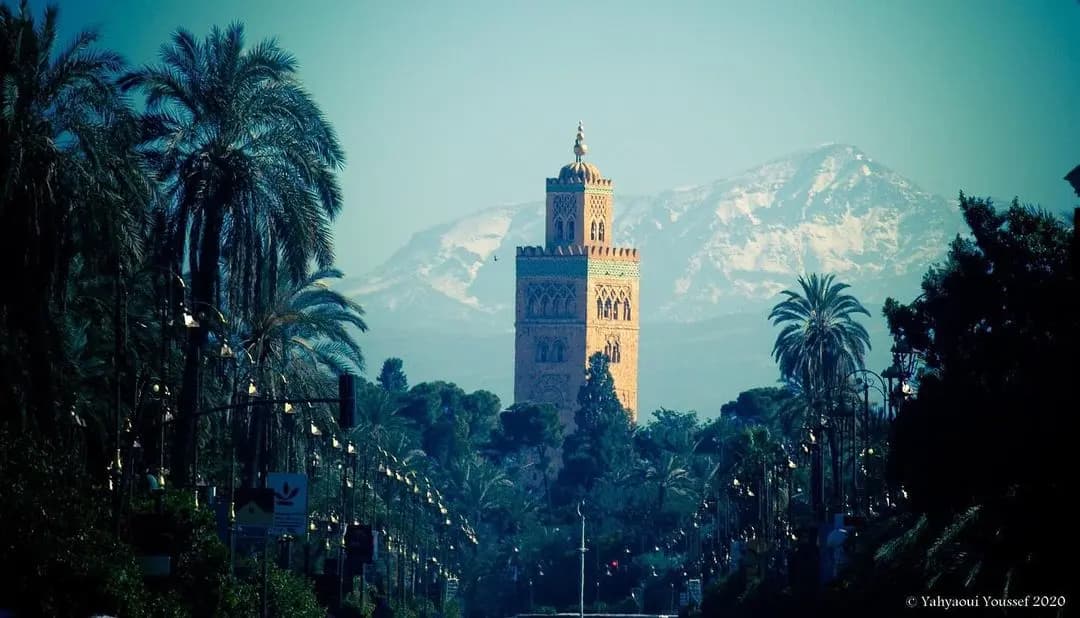
The palace is located in the southeast of the medina, near the Mellah district, Marrakech's ancient Jewish quarter. On foot from theplace Jemaa el-FnaIf you're on the outskirts of Marrakech, allow 10 to 15 minutes on Rue Riad Zitoun el Jdid, an easy-to-follow shopping street lined with spice, leather and pottery stalls. By small (beige) cab, ask for the meter for a journey of a few dirhams; Marrakech has no metro. The nearest parking lot is on theKoutoubiaa ten-minute walk away.
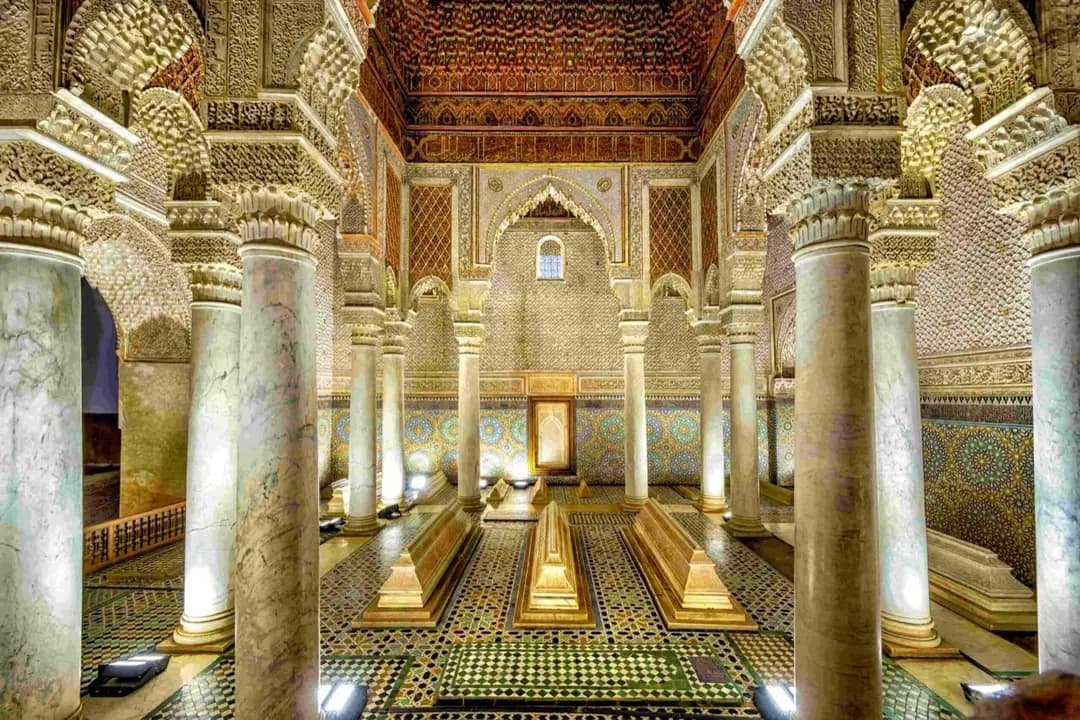
Take advantage of the trip to follow up withsaadian tombsFive minutes away, and the nearby El Badi Palace: all three sites are located in the same southern sector of the medina and can be visited in half a day. The Place des Ferblantiers, just a stone's throw away, is a good place to take a break between visits, with its coppersmiths at work and a few café terraces.
Bahia or El Badi: which to choose?
Just an eight-minute walk from each other, these two palaces are often confused, even though they have almost nothing in common. To quickly decide:
- The Bahia Palace (late 19th century) is intact and richly decorated: a good choice for zelliges, painted ceilings and gardens.
- The El Badi palace (16th century, Saadian dynasty) is in ruins: vast esplanades, ponds, storks' nests and a panoramic terrace overlooking the medina and the Atlas mountains.
- If you only have time for one and like the decor, choose La Bahia; if you prefer the atmosphere of the ruins and the overall view, choose El Badi.
- Both can easily be combined in half a day, with the Saadian tombs, in the same southern quarter of the medina.
Our tips for avoiding the crowds
A few simple reflexes can transform your visit:
- Arrive at opening time, 9am: the courtyards are deserted and the low-angled light is ideal for photos.
- Avoid the 11 a.m.-2 p.m. slot, the busiest, when groups and cruise passengers flock.
- Visit on weekdays rather than weekends, if your schedule permits.
- Look up: the finest decoration is on the ceilings, which most visitors ignore.
- In summer, bring water and a hat: the large courtyards are in direct sunlight.
- Make the most of your trip by combining a visit to the Saadian tombs with a stroll through thesouks.
The Bahia Palace is one of the most photogenic highlights of a day in the medina. To organize the rest of your stay, see our guidewhat to do in Marrakechand theMarrakech city page. And if the palace's zelliges have inspired you to find out how they are made, continue your visit with azellige workshop in Marrakechalongside a master craftsman.