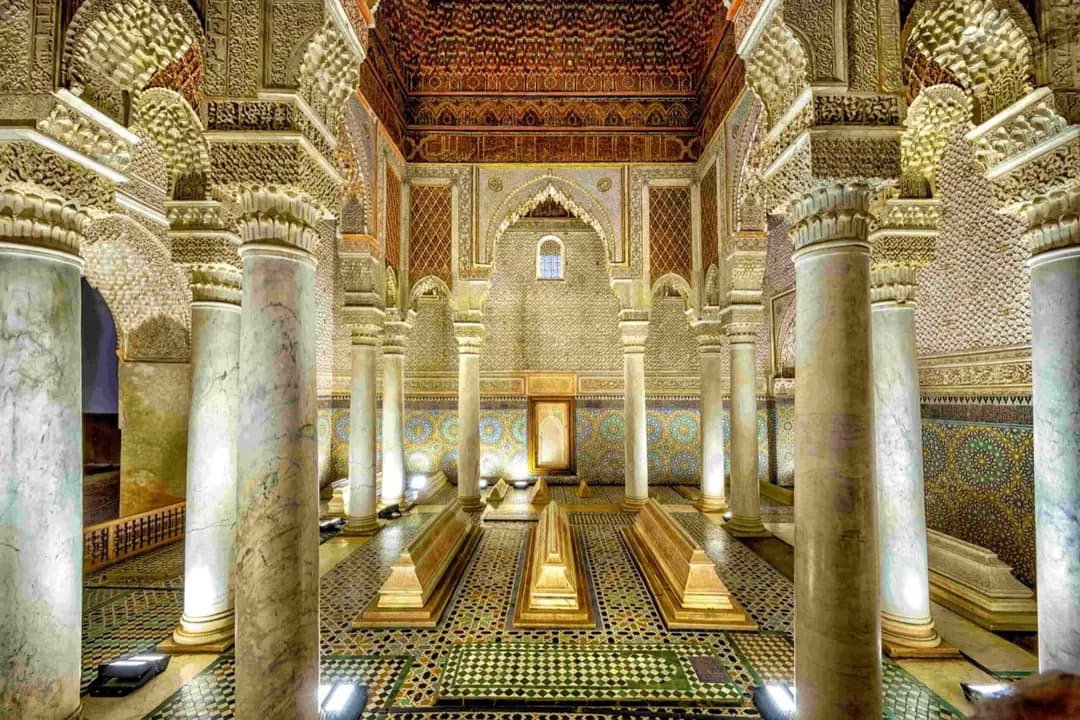
Visitsaadian tombsare the necropolis of the Saadian dynasty, in the Kasbah district of Marrakech, next to the Kasbah mosque. Walled off for almost two centuries, then rediscovered in 1917, they house the tombs of the great Sultan Ahmad al-Mansour and his dynasty, under cedar domes, chiselled stucco and Carrara marble. The site is small, and its most famous room can be discovered from a narrow corridor where a queue often forms. Here's our 2026 guide: prices, opening hours, queues, what to see and how to enjoy it at the right time.
Infos pratiques
Are the Saadian tombs worth the wait?
Yes, the Saadian tombs are worth a visit, provided you know what to expect. The site is small and its centerpiece, the Hall of Twelve Columns, can only be seen from a narrow corridor, in front of which a line almost always forms by mid-morning. The necropolis houses the tombs of the Saadian dynasty, including that of Sultan Ahmad al-Mansour, under cedar domes, finely sculpted stucco and beautiful Carrara marble. But it doesn't take long to get around it: allow 30 to 45 minutes. Our advice: come as soon as it opens at 9 a.m. or in the late afternoon, avoid the 10 a.m.-1 p.m. slot, and wait a few minutes in front of the corridor, as the view of the Hall of Twelve Columns is well worth the wait.
Let's be clear on one point: the Saadian tombs are not a large monument to be explored, but a concentrated funerary complex, where the value lies in the finesse of the decoration and the history of the site, not in its surface area. Coupled with another site in the district, they make an ideal half-day tour of the southern medina.
For whom the visit is made: lovers of Islamic art and history, and all those touched by the romantic destiny of a site that was walled up and then forgotten for two centuries. For whom it's not: if you're worried about crowds and waiting, and you've only got an hour, it's better to aim for the opening or give up rather than wait in line in the middle of the morning. Tickets are still cheap, but it's your time, not your money, that's at stake here. Well-planned, the visit is one of the most memorable in the medina; badly timed in the middle of the morning, it can amount to a long wait for a few minutes in front of a crowded corridor.
Prices, opening hours and queue at the Saadian Tombs
Admission is not free, and tickets can be purchased at the ticket office at the entrance to the alley leading to the necropolis.
How much does a ticket to the Saadian tombs cost?
Here is the tariff schedule for 2026:
- Foreign adult: DH100 (approx. €10)
- Foreign children aged 7 to 13: DH30
- Resident in Morocco, upon presentation of CIN or residence permit: 30 DH
Some guides still show 70 dirhams, an out-of-date price. The adult price for 2026 is 100 dirhams; these amounts are subject to change, so check with the ticket office.
Timetables and best times to avoid queuing
The tombs open every day, generally from 9am to 5pm, with the last entrance around 4:45pm and shorter opening times during Ramadan. Depending on the period, there may be a break in the middle of the day: if in doubt, check at the entrance. The busiest time is between 10am and 1pm, when groups and cruise passengers arrive; this is precisely the time to avoid.
To avoid queuing in front of the Hall of Twelve Columns:
- Arrive as soon as it opens, at 9 a.m.: this is the only time when the corridor remains free-flowing.
- Or come late afternoon, after 3pm, when the groups have gone home.
- Avoid the 10am-1pm time slot and, if possible, busy days (weekends, vacations).
- Once there, visit the garden and other rooms first, then return to the corridor when it clears.
- Have your camera ready before you arrive at the threshold: we photograph from the corridor, without lingering to let the next person pass.
What to see: the Hall of Twelve Columns and the garden
The visit is organized around two main mausoleums and a garden dotted with tombs. Everything fits into a small space, but each room is worth a visit. Highlights, in order of visit:
- The Hall of Twelve Columns: the mausoleum of Ahmad al-Mansour, the highlight of the visit.
- The hall of the three niches: more sober, with beautiful marble steles.
- The mausoleum of Lalla Messaouda: the sultan's mother, in an older building.
- The garden: a hundred or so tombs on the ground among the trees, away from the crowds.
Understanding this distribution helps you to organize your visit, and to wait intelligently when the corridor to the main hall is crowded.
The Hall of Twelve Columns, the masterpiece
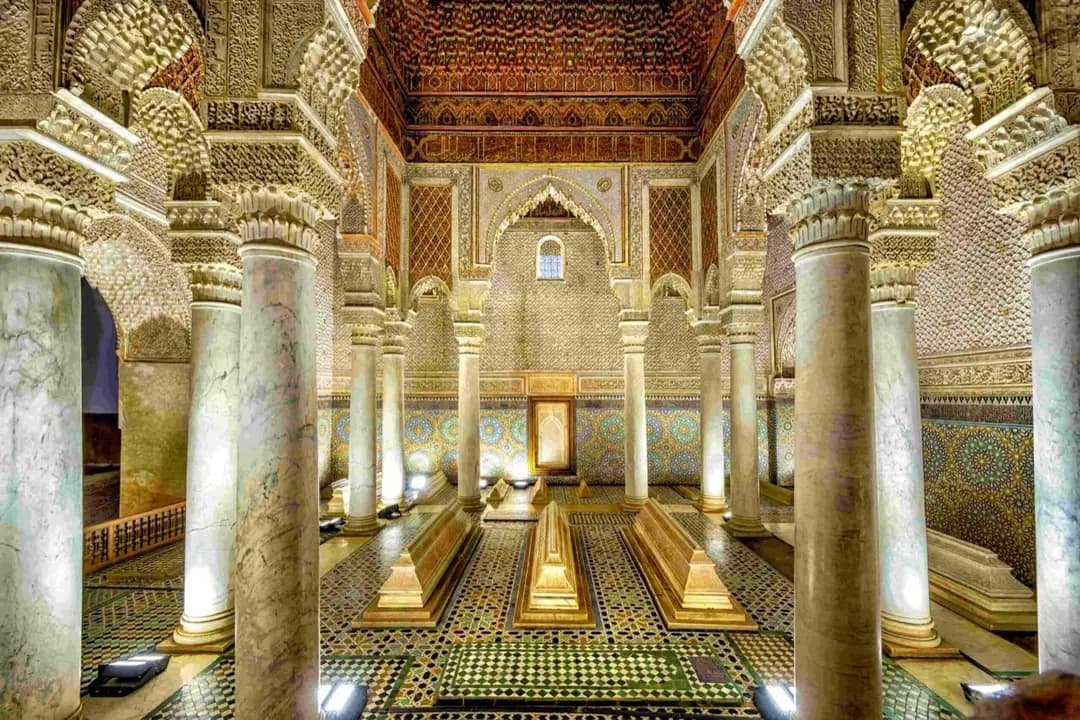
This is the reason for the long queue, and it's well worth it. This room houses the tomb of Ahmad al-Mansour and his relatives, under a carved and gilded cedar dome supported by twelve Carrara marble columns arranged in a square. The walls blend polychrome zellige at the bottom, openwork stucco chiselled with floral motifs and inscriptions, and muqarnas (honeycomb cells) that play with the light. On the floor, finely engraved white marble stelae mark the graves. You don't enter the room: you admire it from the threshold, behind a barrier, which explains the wait when several visitors want to observe and photograph at the same time. This is also why a wide-angle lens is useful, given the lack of distance.
Right next door, the Hall of the Three Niches, more spare but elegant with its aligned stelae, and the mausoleum of Lalla Messaouda, al-Mansour's mother, which is older and more intimate, complete the ensemble. The latter is actually the oldest building in the necropolis, predating the great decorative campaigns. These spaces are almost always quieter than the Hall of the Twelve Columns: take advantage of this to wait until the main corridor is free, and observe the difference in style between the periods.
One detail strikes attentive visitors: the quality of the workmanship never falters, even on the most modest tombs. Epitaphs are meticulously calligraphed, zellij is adjusted to the millimeter, and the whole exudes a rare harmony for a funerary site. This is what distinguishes the Saadian tombs from a mere historical curiosity: they represent the artistic apogee of a dynasty.
The garden and the tombs on the ground
Around the mausoleums, a small garden planted with trees shelters around a hundred tombs on the ground, many of them of children and court relatives, marked by steles and zelliges faded by time. The graves of soldiers and loyal servants stand side by side with those of princes, in a hierarchy that can still be seen in the richness of the steles. It's a peaceful place, away from the madding crowd, where you can appreciate the true scale of the necropolis: over a hundred tombs spread over a modest plot of land. The medina's cats nap in the sun, and you can hear the call to prayer from the nearby mosque. Take the time to stroll around while the Hall of Twelve Columns is being cleared: it's often the best and quietest part of the visit.
History of the Saadian tombs: from glory to oblivion
The site's history is as fascinating as its décor, and explains why it has survived the centuries almost intact.
Ahmad al-Mansour, the golden sultan
The necropolis was built at the end of the 16th century by the Saadian sultan Ahmad al-Mansour ed-Dahbi ("the Victorious, the Golden"), who reigned from 1578 to 1603 and turned Marrakech into a sumptuous capital, enriched by the trade in gold and sugar from the south. For his own mausoleum, he commissioned Carrara marble from Italy, which, according to tradition, was paid for by the weight in sugar. Craftsmen displayed all the skills of the period: cedar marquetry, sculpted stuccowork, mosaics and calligraphic epitaphs. The Saadian dynasty buried its sultans, their families and trusted servants here, making the site one of the most refined funerary ensembles in the Arab world at the time.
Al-Mansour was one of the most powerful rulers in Moroccan history: after repelling the Portuguese at the Battle of the Three Kings in 1578, he extended his influence as far as Sudan and the Niger River, whose caravans brought back the gold that financed his construction projects, starting with the nearby El Badi Palace. His death in 1603, during a plague epidemic, ushered in a period of unrest that weakened the dynasty. The tombs of his successors, less sumptuous, bear witness to this decline: as you stroll through the necropolis, you can read, room by room, the greatness and then the twilight of the Saadians.
Saadian tombs walled up by Moulay Ismaïl, rediscovered in 1917
At the beginning of the 18th century, the Alawite sultan Moulay Ismaïl, who was erasing all traces of the previous dynasty and dismantling the nearby El Badi palace, did not dare desecrate the necropolis out of religious respect for the dead: he preferred to wall it off, leaving only a discreet passage from the nearby mosque. The site fell into oblivion for almost two centuries, known only to the faithful who accessed it from inside the mosque. It was not really rediscovered until 1917, when it was spotted from the air on aerial photographs taken by the Geographical Service, then cleared, studied and restored by the Protectorate's Fine Arts Department. A new entrance was then opened to allow visitors to explore the site without passing through the mosque. It is this enforced isolation of two hundred years that has preserved the Saadian tombs in such remarkable condition, where most of Marrakech's other Saadian monuments have either disappeared or been dismantled.
How to get there and what to see
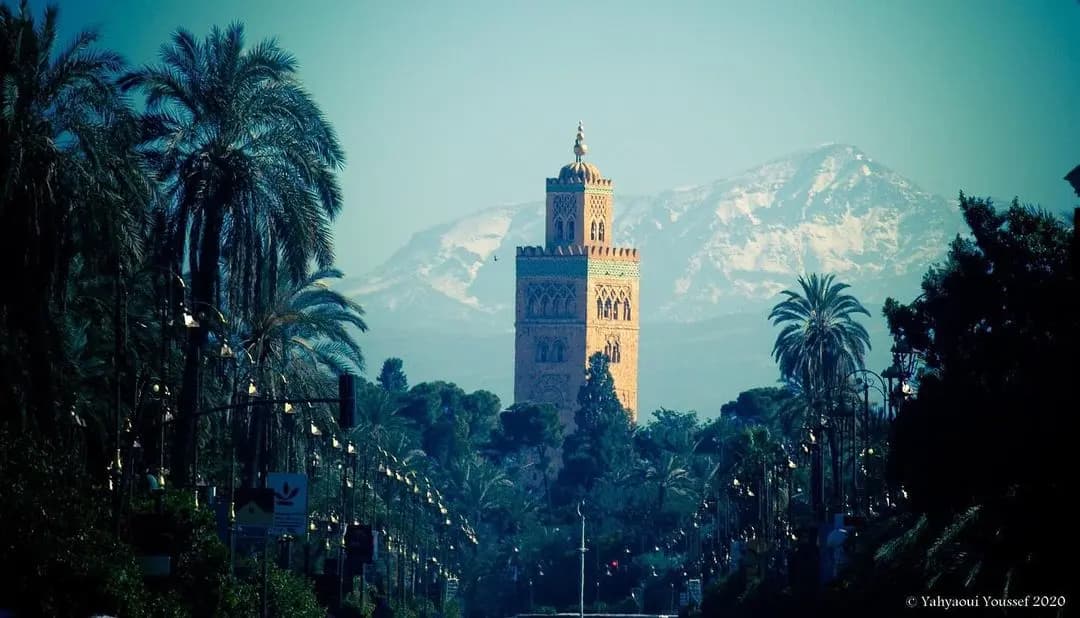
The Saadian tombs are located in the Kasbah district, south of the medina, next to the Kasbah mosque and its beautiful green ceramic minaret, a landmark visible from afar. From theplace Jemaa el-FnaTo reach the mosque, it's a fifteen-minute walk southwards, through the Mellah, the old Jewish quarter; if you're taking a small cab, ask for the meter for a short trip costing just a few dirhams. Access to the site is via a narrow, well-signposted alley that runs alongside the mosque and leads to the ticket office. It's this same narrowness that creates the queue inside: don't be discouraged if the entrance seems modest, it's normal.
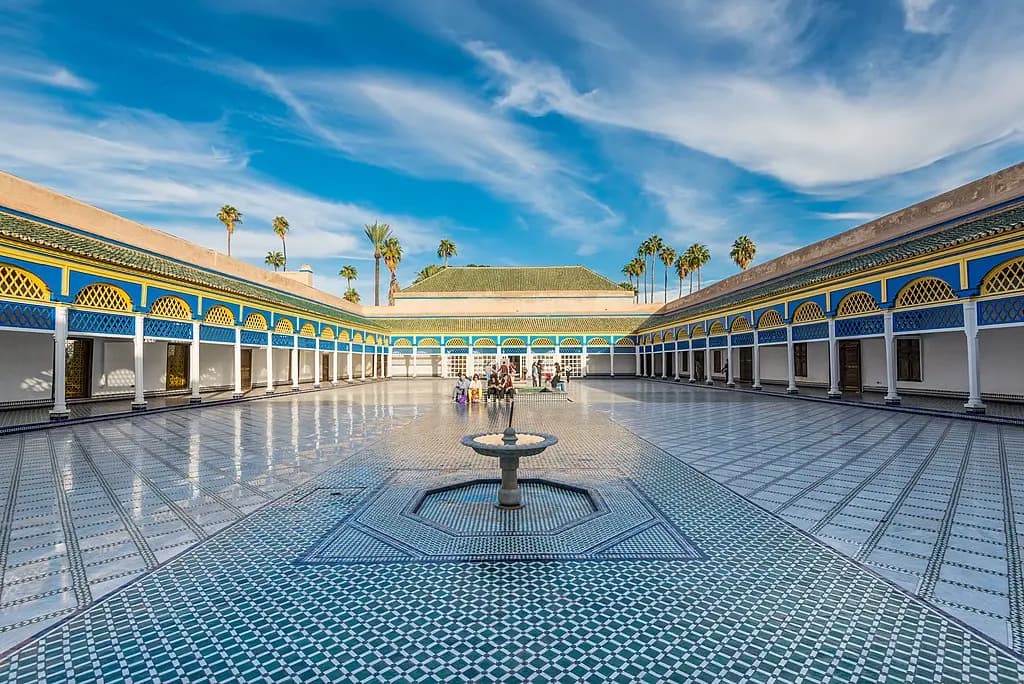
The district lends itself wonderfully to this sequence of events. The El Badi palace, dismantled by Moulay Ismaïl but spectacular with its esplanades and storks, is a five-minute walk away: visiting it just after the tombs gives full meaning to the history of the Saadian dynasty, one of whom built the necropolis and the other destroyed the palace. TheBahia PalaceThe Place des Ferblantiers, a little further on, completes the half-day tour of this southern sector. The nearby Place des Ferblantiers is a good place to stop for a mint tea between two visits, to the sound of the hammers of the coppersmiths working the metal right next door.
To organize the rest of your stay, see our guidewhat to do in Marrakechand theMarrakech city page. To the north of the medina, extend thesouksand theBen Youssef medersaanother pinnacle of Saadian art in Marrakech. And if you're fascinated by the marble, muqarnas and stucco of the tombs, you can learn more about the craftsmen who perpetuate these techniques by booking a guided tour.zellige workshop in Marrakechor apottery workshopwith a master.