The Olhão Garden is a free public park in downtown Agadir, in the Nouveau Talborjt neighborhood. Opened in 1992 to celebrate the sister-city relationship between Agadir and the Portuguese city of Olhão, it covers 2.4 hectares of white kiosks, azulejos, and bougainvilleas, and is home to the Mémoire d’Agadir Museum, dedicated to the February 29, 1960, earthquake.
It takes 20 to 30 minutes to walk around the park, or 1 to 1.5 hours if you include the museum. Here’s what you need to know before stepping through the gate: its history, what you’ll see, hours, admission prices, and our tips for visiting in 2026.
Practical information
Is the Olhão Garden worth a visit? Our honest opinion
That's the question everyone asks after reading conflicting reviews, and the one most guides avoid. The straight answer: yes, if you're staying in downtown Agadir; it's more of a question mark if you have to make a long trip specifically to get to the beach.
The Olhão Garden has a rating of 3.8/5 on TripAdvisor, an average that neatly sums up the divide in opinions: Those who have simply passed through describe it as a calm and welcome respite, while those who made a special trip there from the hotel district find it too short. Both are right.
It’s not a spectacular botanical garden: it’s a well-maintained, shaded ornamental garden inspired by Portuguese design. What gives it depth is the Mémoire d’Agadir Museum located at its entrance. Without the museum, the visit is pleasant but brief. With it, you’ll leave with an understanding of Agadir’s past that few other visits offer.
Allow 20 to 30 minutes for the garden alone, or 1 to 1.5 hours if you include the museum. If a site lists “a 2-hour visit” for the garden alone, that’s inaccurate: the park covers 2.4 hectares and can be explored at a leisurely pace in half an hour. It’s best to include it as part of a half-day trip to the city center, rather than making it a stand-alone destination.
Why the Olhão Garden Is More Than Just an Urban Park
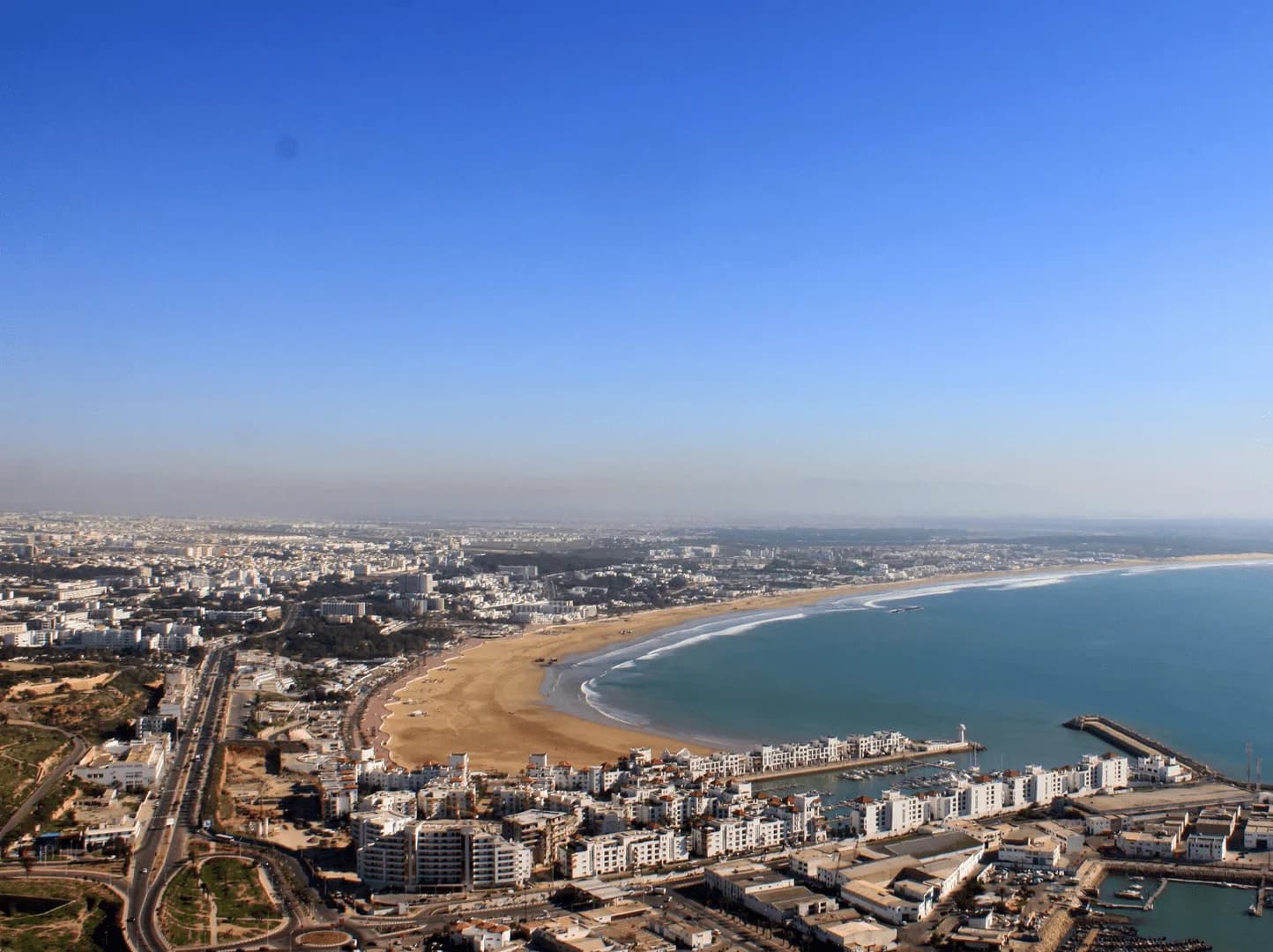
Agadir doesn't have many public gardens worthy of the name. The city was rebuilt after the 1960 earthquake according to a modern urban design that is spacious but often sterile. The Olhão Garden is one of the few green oases in the city center, and that is what makes it so valuable to both Agadir residents and visitors alike.
Inaugurated on March 2, 1992, Throne Day, the garden was originally conceived as a diplomatic memorial: it commemorates the sister-city agreement signed in 1987 between Agadir and Olhão, a fishing port in the Algarve on Portugal’s southern coast.
Five years after the agreement was signed, the city of Agadir sought to give tangible expression to the friendship between the two Atlantic cities through a concrete public space. This is what sets this park apart from a mere decorative square: it is conceived as a symbolic work of art, not as an ordinary green space.
Another aspect that makes this place unique is the Mémoire d'Agadir Museum, located at the southeast entrance. It isn't a separate museum that you visit before or after your walk-it's integrated into the promenade, as if the garden and history were one and the same.
After eighteen months of work carried out by SDL Agadir Souss-Massa Aménagement with a budget of 16 million dirhams, the garden reopened to the public on June 25, 2023. It now boasts a refreshed look: new paving, restored pergolas, fountains once again flowing with water, and the incorporation of Amazigh motifs from the Souss region alongside the original Portuguese elements.
The Agadir-Olhão Sister City Partnership: Why a Portuguese City in Agadir?
To understand why there is a Portuguese garden in Agadir, we need to go back in time.
The earliest historical connection dates back to 1505. That year, the Portuguese founded a coastal fortress, Santa Cruz do Cabo de Gué, on the Agadir coast. For thirty-six years, they occupied the bay before being driven out by the Saadian sultan Mohammed ech-Cheikh in 1541. This Portuguese presence left its mark on local history.
The second, more recent connection is one of solidarity. On February 29, 1960, an earthquake devastated Agadir, killing between 12,000 and 15,000 residents. Olhão, a Portuguese fishing town in the Algarve, joined in the relief and reconstruction efforts. This assistance cemented a lasting friendship between the two Atlantic cities.
In 1987, the sister city relationship was formalized. Olhão also has its own “Praça de Agadir” right in the city center, as a tribute to its Moroccan sister city. A few years later, in 1992, Agadir responded by creating this garden. This symmetry has become a defining feature of both coastlines.
For the curious visitor, this garden tells a story that goes far beyond a mere formal friendship between two municipalities. It recounts five centuries of shared Atlantic history: conquest, resistance, tragedy, and solidarity.
Activity category
Things to do in Agadir
Discover our immersive experiences on this theme, designed with local artisans and guides.

Agadir Raffia Workshop: Hand Weaving with Bouchra
From 30 €

Pottery Workshop in Agadir: Make 3 Pieces with an Artisan
From 35 €

Jewellery Making Workshop in Agadir: Horn Carving with Mohamed Salhi
From 39 €

Metal Jewellery Workshop in Agadir: Brass and Copper
From 40 €
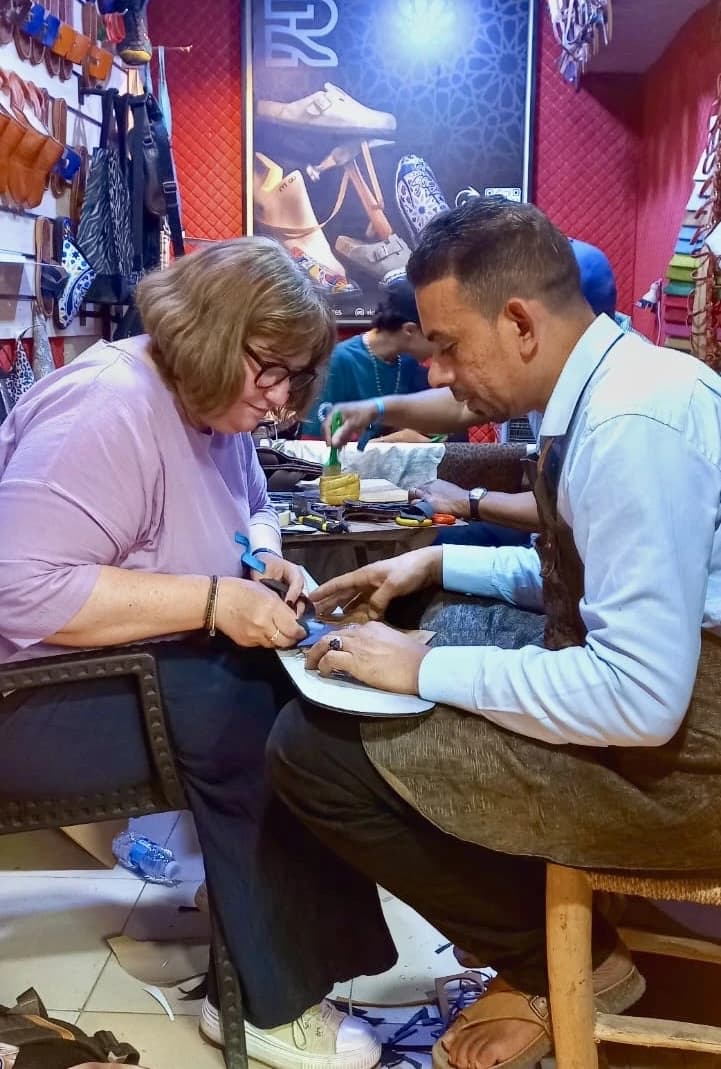
Agadir Sandal Workshop: Custom Leather Sandals with Redouane
From 45 €

Carpet Weaving Workshop in Agadir with Fatima
From 45 €
What You'll See in the Olhão Garden
The main entrance opens onto a central paved path that defines the layout of the entire garden. Visitors are immediately struck by the color palette: white, blue, and green. These three colors evoke the Algarve even before one realizes where the inspiration came from.
The whitewashed kiosks are the most recognizable feature. Placed at regular intervals along the promenade, they are modeled after the pavilions found in Portuguese seaside resorts. With tiled roofs, wooden trellises, and stone benches, they provide shelter from the sun and places to rest. Several are decorated with azulejos-those typically Portuguese glazed ceramic tiles-featuring floral or geometric patterns.
The pergolas extend the path and create shady tunnels covered with bougainvilleas. Depending on the season, the flowers burst into bloom in shades of pink, purple, or white. It’s one of the most popular photo spots.
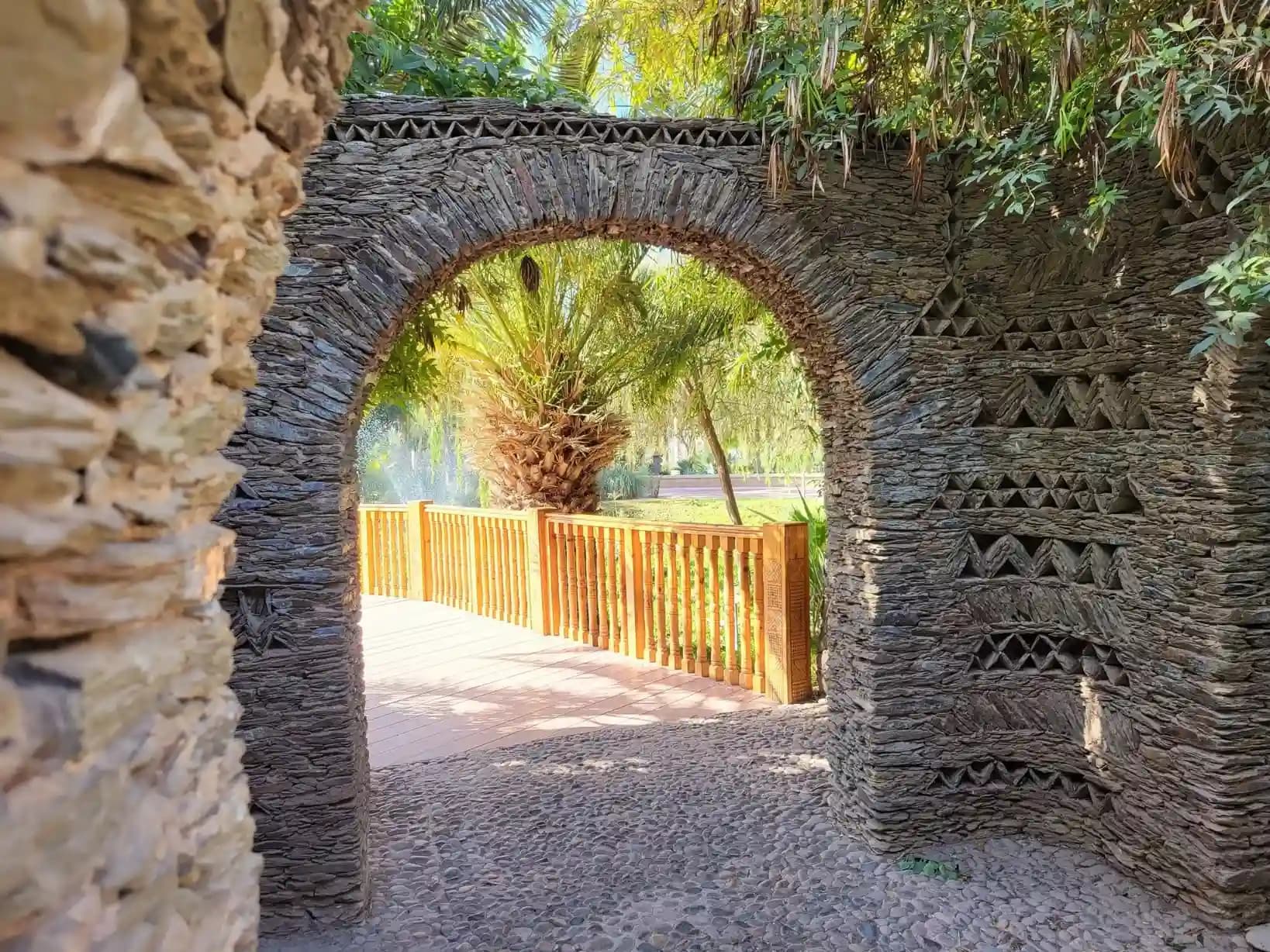
Several fountains and ponds dot the path. The central pond, restored in 2023, is home to water lilies and goldfish. The side fountains operate in a closed-loop system and provide the sound of running water that softens the city’s hubbub. Several small wooden bridges added during the renovation cross these water features.
The vegetation blends Mediterranean and Moroccan species:
- Washingtonia and Phoenix palms
- bougainvilleas, hibiscus, jasmine
- oleanders
- cacti and succulents
- themed paths showcasing plants from the Souss region
The 2023 renovation added a new dimension: the incorporation of Amazigh architectural elements from the Souss region. Decorative motifs carved into the stone, trellises inspired by the kasbahs of the Anti-Atlas Mountains, and local stone. This blend of Algarve and Souss-Massa styles makes the place truly unique. Several commemorative plaques, scattered throughout the garden, recount the history of the sister-city relationship between the two towns.
The Mémoire d'Agadir Museum: The Story of the 15 Seconds That Wiped Out the City
At the southeast entrance to the garden is the Mémoire d'Agadir Museum. Don't miss it: it is undoubtedly the most important part of the complex, and by far the most moving.
The museum is entirely dedicated to the earthquake of February 29, 1960. The strength of the collection lies in its dual perspective: before and after.
First, you’ll discover the Agadir that is no more-a city built around the Oufella Kasbah, bustling with life in its Talborjt and Founty neighborhoods, complete with its squares, mosques, and narrow streets. Black-and-white photographs, postcards, and maps: everything is there to bring a vanished urban landscape to life.
Then there was what remained of it on the morning of March 1, 1960. At 11.40pm the previous night, a 5.7-magnitude earthquake struck the city for about fifteen seconds. The toll: between 12,000 and 15,000 dead, 25,000 injured, 35,000 homeless, and 90% of the buildings destroyed.
Images of the ruins, rescue efforts, and survivors follow one after another. Several salvaged objects are displayed in the showcases: watches frozen at 11.40pm, utensils warped by the heat of the fires, and architectural fragments recovered from the rubble.
A video section features testimonies from survivors filmed at various times. This is the most poignant part: their voices still tremble more than sixty years later. A final room is dedicated to international solidarity, in which Portugal played a significant role. It is this section that explains why the museum is located in a garden dedicated to the Agadir-Olhão sister-city partnership.
Please note: This museum should not be confused with the Bert Flint Museum in Agadir (located near the open-air theater and dedicated to Amazigh crafts from the Souss and the Sahara) and from the future Agadir Reconstruction Museum, which will focus on the city’s modernist urban planning after 1960.
Hours, Admission Prices, and Directions to the Olhão Garden
The garden and the museum have different hours and admission policies. Here is the most up-to-date information, subject to seasonal changes, which should be verified on site.
The Garden of Olhão
- Home: free
- Hours: Open daily, usually from 8am to 7pm since the renovation
- Duration of visit: 20 to 30 minutes to walk around the park
The Mémoire d'Agadir Museum
- Home: about 10 dirhams (1 euro), free for children on certain days
- Hours: 9.30am-12.30pm and 2.30pm-6.30pm (times may vary depending on the season)
- Weekly Closure: Closed on Mondays
- Duration of visit: 45 minutes to 1 hour
- Languages: signs in Arabic, French, and English
How to get to the Olhão Garden
The garden is located on Avenue du Président Kennedy, in the Nouveau Talborjt neighborhood, right in downtown Agadir.
- On foot: 10-15 minutes from Hassan II Avenue, 15-20 minutes from the Corniche, depending on your starting point
- By taxi: 10 to 20 dirhams from anywhere in the city
- By car: No designated parking; street parking is available on Hassan II Avenue or adjacent streets, which is often full during the day
Combine both visits (garden + museum) for about 1 to 1.5 hours total: that’s just the right amount of time.
When is the best time to visit the Olhão Garden?
The right timing makes all the difference. Here are our guidelines.
Morning (9.30am-11am)
This is our favorite time to visit the museum. The light is still soft, there are fewer people, and you’re in a better frame of mind to take in the museum’s rich content. Plan your visit in this order: the museum first, then relax in the garden.
Mid-afternoon (3-5pm)
The air is starting to cool, and the garden is filling up with local strollers. This is the liveliest time of day: kids from the neighborhood come to play in the paths, and a local atmosphere is guaranteed.
Late afternoon (5-7pm)
This is the “golden hour.” The white walls of the kiosks take on a slight reddish hue, the azulejos regain their blue tones, and the bougainvilleas stand out in sharp contrast. It’s photographers’ favorite time of day.
Things to Avoid
The 12pm-2pm time slot is less pleasant: it’s hot in the walkways, there are harsh shadows, and the museum is closed for lunch. On Mondays, the museum is closed, so your visit is limited to the garden only.
Extend Your Visit: Other Places Near the Olhão Garden
The Olhão Garden is a great place to spend half a day in the city center. There are several logical places to visit next, either on foot or by a short taxi ride.
1 kilometer away, the Agadir Waterfront features a 6-kilometer-long pedestrian promenade overlooking the Atlantic. The garden for culture and remembrance, the promenade for relaxation: the two complement each other well.
2.5 kilometers away, the El Had Souk in Agadir spans 13 hectares of a bustling market. While the garden offers a serene side of Agadir, the souk is its vibrant counterpart: a wonderful contrast within a single day.
10 kilometers away, the Kasbah Oufella, perched on its hill, perfectly rounds out a visit to the Mémoire Museum. The museum tells the story of the earthquake from the perspective of downtown, while the kasbah tells it from the viewpoint. The cable car inaugurated in 2022 makes the climb much easier.
Finally, 4-5 kilometers to the south, the Medina of Agadir, reconstructed by Coco Polizzi, extends the artistic and architectural dimensions of the visit. While the Olhão Garden is the official interpretation of Agadir's history, the Polizzi Medina is the artist's interpretation.
To help you plan the rest of your stay-including sights, activities, and excursions starting from the city-our guide Things to Do in Agadir lists everything Agadir and its surrounding area have to offer in 2026, and the Agadir City Page summarizes our recommendations.
In summary
The Olhão Garden in Agadir is a short visit (20 to 30 minutes) that really comes into its own when combined with the Mémoire d’Agadir Museum: allow 1 to 1½ hours in total.
Admission is free; it’s located on Avenue du Président Kennedy in Nouveau Talborjt, and the museum is open daily except Mondays. It encapsulates several layers of Agadir’s history: the Portuguese presence since 1505, the tragedy of the 1960 earthquake, the 1987 twinning with Olhão, and the 2023 Amazigh-inspired renovation.
Start by visiting the museum in the morning, enjoy the garden in the late afternoon when the light shines golden on the azulejos, and make the visit part of a half-day tour of the city center rather than treating it as a standalone destination. You’ll leave with a much deeper understanding of Agadir than you would from a simple beach vacation, and you’ll understand why, 2,500 kilometers away, Olhão also has its own Praça de Agadir.